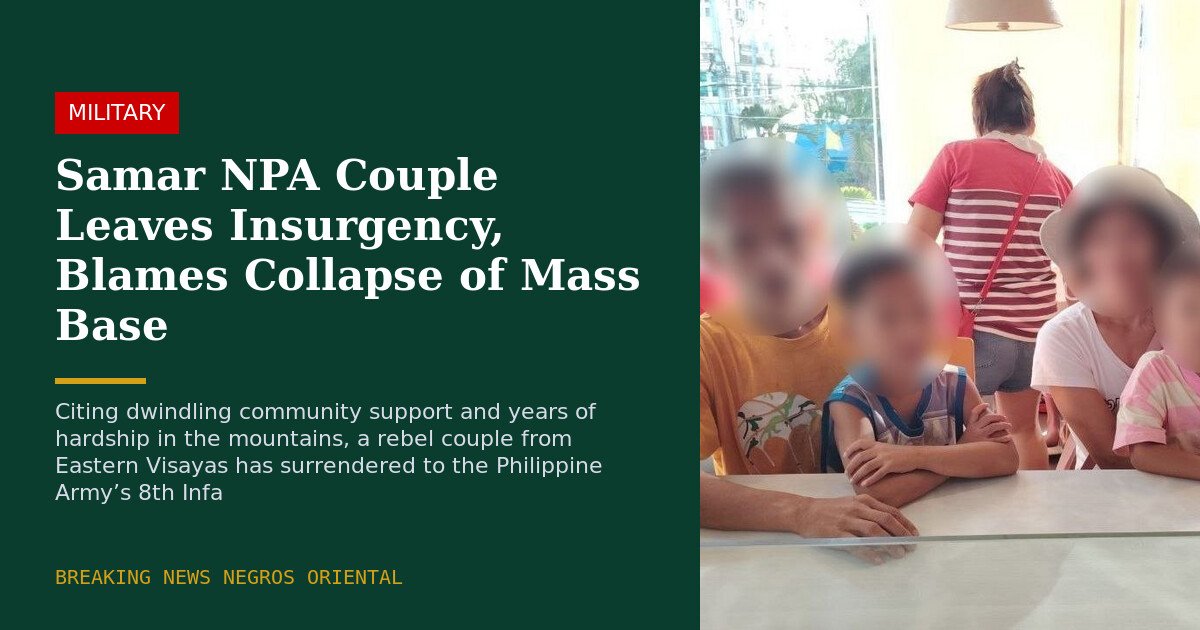
Two members of the communist insurgency in Eastern Visayas — a husband and wife who held positions within the underground movement’s regional structure — have voluntarily laid down their arms and turned themselves over to government forces, driven by physical exhaustion, the collapse of logistical support, and a frank admission that the communities they once relied upon had turned against them.
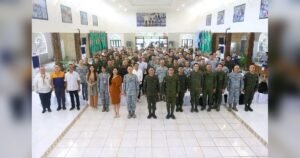
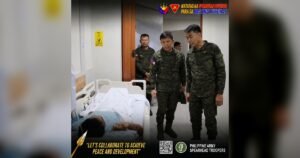
The 8th Infantry Division (8ID) of the Philippine Army announced the surrender at Camp Lukban in Catbalogan City, Samar. The couple, operating under the aliases “Aga” (wife) and “Bigo” (husband), were both affiliated with the Sub-Regional Committee Sesame, operating under the Eastern Visayas Regional Party Committee (EVRPC).
Life in the Hinterlands Grew Unbearable
According to the 8th Infantry Division, the couple described conditions inside the movement as increasingly impossible to endure. Bigo spoke of the relentless need to keep moving, to evade government security forces, and to live with the constant awareness that death was never far away. He said a particularly powerful factor in his decision was the thought of his children growing up without either parent — a future he was no longer willing to risk.
Aga, for her part, told military officials that food and other basic necessities had become critically scarce within their unit. She also cited the loss of their arms cache as a blow that severely diminished the group’s capacity to sustain armed activities. Together, both described the cumulative weight of years spent in the mountains — isolated from family, from normal society, and from any meaningful sense of a future.
Communities Had Seen Through the Movement’s Tactics
While physical hardship was a significant factor, the couple pointed to something more fundamental as the decisive reason for leaving: the movement’s steady loss of its mass base.
In a statement quoted by the 8th Infantry Division, Bigo explained in the Waray language that the most important reason for their departure was the erosion of community support — not through government pressure alone, but through the growing awareness of local residents themselves.
“The most significant reason why we decided to leave was the erosion of the movement’s support among the very communities it once claimed to represent,” Bigo said, as translated and released by the 8ID. “The local population had grown aware of our schemes and tactics, resulting in a steady loss of mass base support.”
This organic withdrawal of civilian cooperation, the 8ID noted, left the couple and their comrades isolated — without the cover, food, intelligence, and safe passage that local communities had once quietly provided to the insurgency for decades.
A Mother’s Longing to Return to Her Children
For Aga, the emotional core of her decision was deeply personal. She expressed a heartfelt desire to reclaim the family life she had sacrificed during her years underground.
“I want to live a normal life with my family,” Aga said in a statement released by the Philippine Army’s 8th Infantry Division. “All I want now is to be there for my children and watch them grow up — something that I missed while I was in the mountains.”
Her words reflect a recurring theme in surrender accounts from former rebels across Eastern Visayas: the recognition, often delayed by years of ideological commitment, that the personal cost of armed struggle had far exceeded whatever cause remained to fight for.
Government’s Localized Peace Engagement Program Gets Credit
The 8th Infantry Division attributed the couple’s surrender to the sustained work of the government’s Localized Peace Engagement (LPE) program. The LPE operates through community-level dialogue, outreach, and coordination with local government units (LGUs) to create pathways for rebels to return to civilian life without fear.
The 8ID said that the consistent cooperation of communities and LGUs across Eastern Visayas had been instrumental in degrading the NPA’s ability to recruit, resupply, and rebuild its support structures in the region. The military stated that the insurgency’s operating space in Eastern Visayas continues to shrink as this cooperation deepens.
Military Calls on Other Rebels to Come Forward
Following the announcement of the couple’s surrender, the 8th Infantry Division issued a direct appeal to rebels still hiding in the mountains across Eastern Visayas. The military urged them to take advantage of existing government peace programs and return to their families while the opportunity is still open to them.
The 8ID said the experience of Aga and Bigo is not an isolated case, but part of a broader and accelerating pattern. As the Philippine Army’s 8th Infantry Division described it, the New People’s Army’s remaining pockets of influence in the region are continuing to contract — squeezed both by military operations and by the increasingly hostile reception that local communities are giving to armed groups that once counted on their silence and support.
The military’s characterization points to a shift that is partly the result of deliberate government strategy and partly the product of decades of accumulated frustration among rural communities that have borne the costs of an insurgency without sharing in whatever benefits it once promised.
Why This Matters
The defection of two mid-level figures from the EVRPC’s organizational structure is a concrete indicator that the NPA’s operational capacity in Eastern Visayas is deteriorating — not only due to military pressure, but due to a ground-level loss of civilian trust that the insurgency cannot easily reverse. The couple’s firsthand testimony that local populations had grown resistant to the movement’s methods provides rare, insider confirmation of what the government’s Localized Peace Engagement program has been working to achieve. Their surrender adds to a pattern that the 8th Infantry Division says is steadily narrowing the insurgency’s room to operate, recruit, and survive in the region.
Source: Philippine Army 8th Infantry Division / wire reports
Related stories