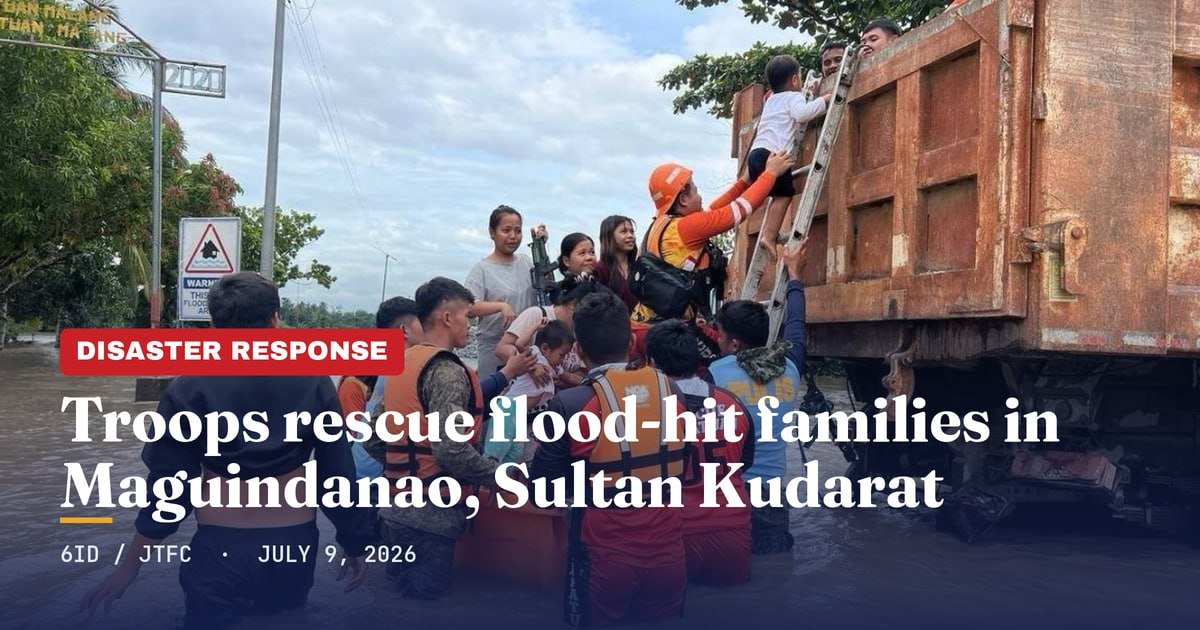
Heavy rainfall that inundated communities across three provinces in central Mindanao prompted the rapid deployment of military rescue teams over two consecutive days, with soldiers wading into flood-affected areas to assist stranded residents and coordinate with local emergency offices, the Philippine Army announced.
The Army’s 6th Infantry (Kampilan) Division and Joint Task Force Central — known collectively as the 6ID/JTFC — confirmed that Disaster Response Units were placed on heightened alert and mobilized across Maguindanao del Sur, Maguindanao del Norte, and Sultan Kudarat on July 8 and 9, according to a statement issued from Camp Siongco in Maguindanao del Norte.
Three Brigades Cover Nine Municipalities
The 6ID/JTFC said in its official statement that response units drawn from the 601st Infantry Brigade, the 603rd Infantry Brigade, and the 1st Marine Brigade carried out humanitarian assistance and disaster response (HADR) operations across a total of nine municipalities spanning the three affected provinces.
In Maguindanao del Sur, the military conducted operations in the municipalities of Ampatuan, Datu Abdullah Sangki, Talayan, and South Upi. Troops in Maguindanao del Norte were deployed to Datu Odin Sinsuat, Barira, and Parang. In Sultan Kudarat, the covered areas included Palimbang and Lebak, the Command confirmed.
According to the 6ID/JTFC, soldiers on the ground assisted individuals who had become stranded by rising floodwaters, conducted systematic inspections of flood-prone zones, and kept close watch on communities where water levels were assessed to be at continued risk of rising further.
Government Agencies Join the Coordinated Response
The military said it did not operate in isolation. Troops worked closely with local government units, Municipal Disaster Risk Reduction and Management Offices (MDRRMOs), barangay officials, and Quick Response Teams to ensure a structured and effective relief effort, the 6ID/JTFC reported.
Also participating in the ground operations, according to the Command, were the Bureau of Fire Protection, the Philippine Coast Guard, and the Philippine National Police. The 6ID/JTFC described the multi-agency collaboration as essential to ensuring a timely and well-organized response to what it characterized as a widespread flooding emergency affecting communities simultaneously across several municipalities.
The involvement of at least seven distinct government agencies and military units in coordinated field operations reflects the scale and complexity of the emergency that the continuous rainfall created across central Mindanao during those two days.
Remaining Units on Standby as Situation Is Monitored
Not all Disaster Response Units under the 6ID/JTFC were immediately committed to active field operations. The Command said that other DRUs remained on standby alert and continued monitoring their respective areas of responsibility, positioned to provide additional assistance should conditions worsen or new communities be affected.
The 6ID/JTFC said in its statement that it remains fully committed to supporting affected communities throughout the duration of the emergency: “The Command continues to monitor the situation within its area of responsibility and remains prepared to support humanitarian assistance and disaster response efforts together with local government units and partner stakeholders.”
As of July 10, the situation across the three provinces was still being actively monitored by the Command, which said it was ready to sustain or scale up operations based on evolving ground conditions, the 6ID/JTFC added.
Context: Central Mindanao Flood Risk
Provinces such as Maguindanao del Sur, Maguindanao del Norte, and Sultan Kudarat are located in areas susceptible to flooding during periods of sustained rainfall, and the concurrent inundation of multiple municipalities underscores how quickly conditions can deteriorate across the region. The activation of DRUs, the rapid coordination among civilian and military agencies, and the sustained monitoring posture as of July 10 all point to an event that placed significant pressure on local disaster management capacity.
The breadth of the military’s response — three brigade-level units covering nine separate municipalities over two days — signals how seriously the 6ID/JTFC assessed the threat to civilian safety during the flooding episode, according to information released by the Command.
By the Numbers
- 3 provinces covered: Maguindanao del Sur, Maguindanao del Norte, and Sultan Kudarat
- 9 municipalities where disaster response operations were conducted
- 3 brigades deployed: 601st Infantry Brigade, 603rd Infantry Brigade, and 1st Marine Brigade
- 2 consecutive days of active operations: July 8 and 9
Why This Matters
Simultaneous flooding across nine municipalities in three provinces demanded a response that exceeded what local disaster offices could handle on their own, requiring the mobilization of three military brigades alongside at least four other government agencies. The scale and speed of the coordinated deployment highlight how extreme weather events are increasingly straining local disaster management infrastructure in central Mindanao. With Disaster Response Units still on standby alert as of July 10, the event had not yet been declared fully resolved, indicating continued risk for affected communities.
Source: Originally reported by the Philippine Army / 6ID-JTFC public affairs office via wire reports