
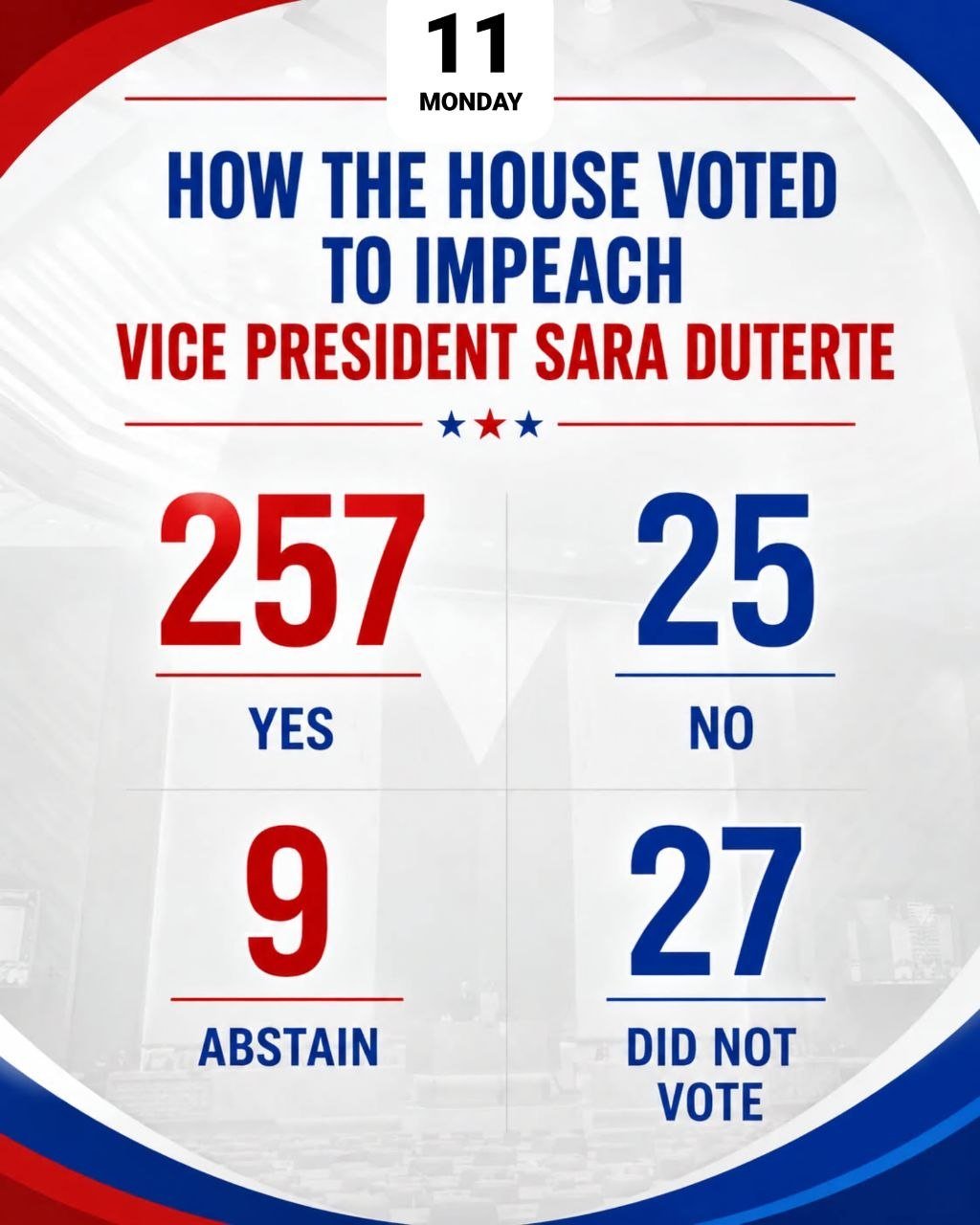
For the second time in less than two years, the House of Representatives has voted to impeach Vice President Sara Duterte — an action that cements her place in an unwanted corner of Philippine political history. On Monday, May 11, 2026, lawmakers overwhelmingly approved the articles of impeachment and formally transmitted them to the Senate, which will now sit as an impeachment court to hear the case against the country’s second-highest official.
No Philippine official has ever been impeached twice by the House, making Monday’s vote a landmark — and deeply controversial — moment in the nation’s constitutional history. The charges leveled against Duterte are sweeping in scope, and the political drama surrounding the proceedings has already begun reshaping the balance of power in the upper chamber.
Overwhelming House Majority Backs Impeachment
The final tally on the House floor stood at 257 votes in favor, 25 against, and 9 abstentions. That margin is not only decisive — it is legally commanding. The 1987 Philippine Constitution requires only one-third of the total House membership, or roughly 106 votes, to approve an impeachment complaint. Monday’s vote more than doubled that threshold.
Notably, the 257 affirmative votes also surpassed the 215 House members who signed Duterte’s first impeachment complaint back in 2025, signaling that political opposition to the Vice President has grown — not shrunk — since that earlier effort. The scale of Monday’s vote reflects a significant consolidation of anti-Duterte sentiment within the lower chamber.
Under the Philippine Constitution, the House holds the exclusive authority to initiate impeachment proceedings. Once articles are transmitted to the Senate, the upper chamber assumes the role of impeachment court and takes over the conduct of the full trial.
Five Broad Categories of Charges Against the Vice President
The articles of impeachment approved by the House enumerate five categories of offenses allegedly committed by Vice President Sara Duterte: culpable violation of the Constitution, graft and corruption, betrayal of public trust, bribery, and other high crimes.
Among the most serious specific allegations are the misappropriation of confidential government funds, failure to comply with legally mandated financial disclosure requirements, and acts of bribery. The complaint also includes charges arising from alleged death threats Duterte purportedly made against President Ferdinand Marcos Jr., First Lady Liza Araneta-Marcos, and former House Speaker Martin Romualdez.
At least two of the constitutional violation charges and the betrayal of public trust count relate directly to her conduct in public office and her obligations under Philippine law, particularly regarding the annual submission of her Statement of Assets, Liabilities and Net Worth.
₱6.7 Billion in Undisclosed Transactions Takes Center Stage
During the sponsorship of the impeachment articles on the House floor, Batangas Representative and House Justice Committee Chairperson Gerville Luistro outlined what she characterized as grave financial irregularities involving the Vice President and her husband, Manases Carpio.
Representative Luistro said the Vice President must account for ₱6.7 billion in bank transactions — money that she and Carpio allegedly failed to include in their joint SALN filing. The SALN, or Statement of Assets, Liabilities and Net Worth, is a document all Philippine public officials are legally required to submit every year, fully disclosing their financial standing.
The impeachment complaint further cites private banking transactions flagged by the Anti-Money Laundering Council (AMLC) amounting to more than $110 million. These financial figures sit at the core of the graft and corruption charges contained in the articles approved by the House.
Background: First Impeachment Voided by the Supreme Court
The events of Monday did not occur in a vacuum. In 2025, the House had already voted to impeach Vice President Duterte, with 215 affirmative votes — a historic act against a sitting Vice President at the time. However, the Supreme Court subsequently struck down that impeachment, declaring the proceedings unconstitutional and effectively halting any Senate trial before it could begin.
That ruling nullified the 2025 effort entirely. Monday’s renewed vote represents the House’s second attempt to bring Duterte before a Senate impeachment court — this time with a larger majority and with lawmakers asserting that the revised articles of impeachment are on firmer legal ground.
Whether the High Court will again be asked to intervene remains an open question as the proceedings move forward.
Duterte Allies Seize Senate Leadership Hours Before the Vote
The impeachment vote did not unfold in isolation. Just hours before the House cast its ballots on Monday, a bloc of senators aligned with Vice President Duterte moved to reorganize the Senate leadership — and succeeded. A majority of senators voted to install Senator Alan Peter Cayetano as the new Senate President, displacing the previous leadership and handing Duterte’s political allies control of the chamber that will now serve as her impeachment court.
The timing of this leadership shift was immediately noted by political observers as consequential. With Duterte’s allies now holding the gavel in the Senate, the structure of the trial — including procedural rulings, the admission of evidence, the pace of hearings, and ultimately the outcome — may be shaped by figures sympathetic to the Vice President.
The convergence of these two events on a single day underscores the intensity and complexity of the political battle now unfolding at the highest levels of Philippine government.
Senate Must Muster Two-Thirds Vote to Convict and Remove
With the articles of impeachment formally before the Senate, the upper chamber will convene as an impeachment court. Proceedings are expected to be lengthy and legally intricate, given the volume of charges and the financial complexity of the evidence involved.
Conviction under the 1987 Philippine Constitution requires the concurrence of two-thirds of all Senate members. If that threshold is reached, Duterte would not only be removed from the Vice Presidency — she would also be permanently disqualified from holding any public office in the country.
The political stakes could hardly be higher. Duterte has long been regarded as a frontrunner for the 2028 presidential election. A conviction and disqualification would end that ambition entirely, fundamentally altering the landscape of the next national campaign. An acquittal, on the other hand, would allow her to remain in office and continue positioning herself for a presidential run.
Given that her allies now lead the Senate, political analysts consider a conviction far from certain. The path through the impeachment court will be watched closely by the public, legal experts, and political stakeholders across the country.
A New Chapter in Philippine Constitutional History
The Philippine impeachment mechanism, enshrined in the 1987 Constitution ratified in the aftermath of the Marcos dictatorship, has been used against several prominent officials over the years — including former presidents and chief justices of the Supreme Court. But Monday’s second impeachment of a sitting Vice President opens an entirely new chapter in how this constitutional tool has been applied.
Sara Duterte is now the first official in the history of the Philippine Republic to have been impeached twice by the House of Representatives. Whatever the outcome of the Senate trial, that distinction alone marks a significant moment in the country’s democratic and constitutional development.
As of Monday, May 11, 2026, no date has been set for the commencement of the Senate trial. The scheduling and conduct of proceedings will fall under the authority of newly installed Senate President Alan Peter Cayetano and will be governed by the Senate’s impeachment rules in the weeks and months ahead.