
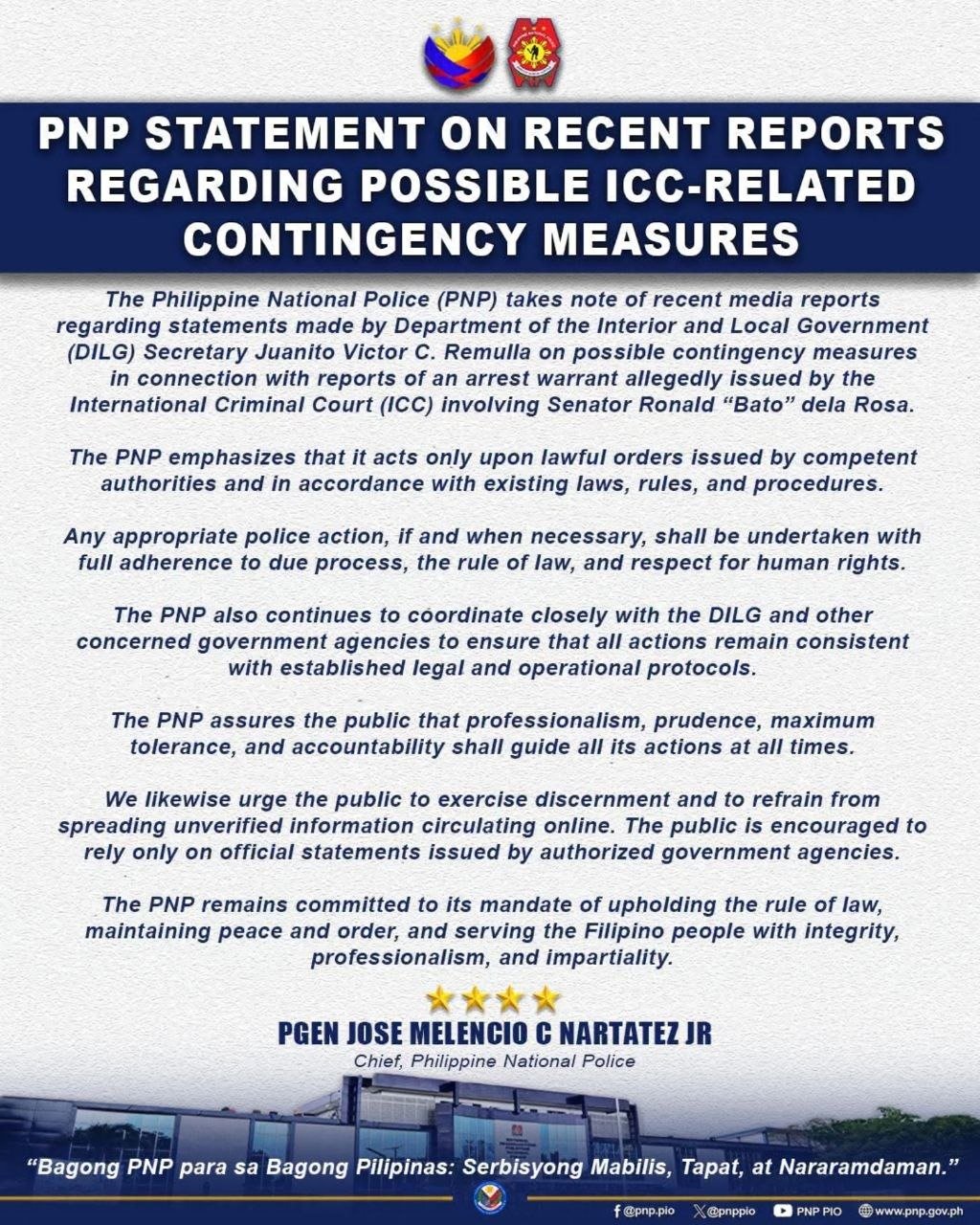
Amid a wave of media speculation and social media chatter surrounding reports of a potential International Criminal Court (ICC) arrest warrant against Senator Ronald “Bato” dela Rosa, the Philippine National Police (PNP) moved quickly on Saturday, May 9, 2026, to assert that it will act strictly within the bounds of the law — and only upon orders from legitimate, competent authorities.
The formal statement, issued under the authority of PNP Chief General Jose Melencio C. Nartatez Jr., was released in direct response to circulating reports that quoted Department of the Interior and Local Government (DILG) Secretary Juanito Victor C. Remulla discussing possible contingency measures tied to the alleged ICC warrant against the veteran senator and former police chief.
PNP Takes Note of DILG Secretary’s Reported Statements
Rather than confirming or denying the existence of an ICC warrant, the PNP chose to acknowledge the media reports without taking a definitive position on their accuracy. The institution stated it “takes note of recent media reports regarding statements made by DILG Secretary Juanito Victor C. Remulla on possible contingency measures in connection with reports of an arrest warrant allegedly issued by the International Criminal Court (ICC) involving Senator Ronald ‘Bato’ dela Rosa.”
Notably absent from the statement were any specifics about what contingency measures — if any — had actually been discussed or formalized within government circles. The PNP declined to elaborate further on the nature of internal planning discussions, keeping its public communication tightly focused on principles rather than operational detail.
Senator dela Rosa’s connection to the ICC proceedings traces back to his role as the lead implementor of the Duterte administration’s controversial anti-drug campaign. As PNP chief from 2016 to 2018, he oversaw the early phase of the drug war, during which thousands of Filipinos were killed. The ICC formally authorized an investigation into alleged extrajudicial killings linked to that campaign in September 2021, and dela Rosa has remained among the most prominent figures in its scope.
Commitment to Due Process Placed Front and Center
At the heart of the PNP’s public communication was a firm reassertion of its institutional obligation to due process and the rule of law. PNP Chief General Nartatez Jr. was unequivocal: “any appropriate police action, if and when necessary, shall be undertaken with full adherence to due process, the rule of law, and respect for human rights.”
The statement further emphasized that the PNP operates as a law-enforcement body governed by existing legislation, established rules, and standard operational protocols — insulating it, at least officially, from political pressure or public sentiment that might push for a different course of action.
“The PNP assures the public that professionalism, prudence, maximum tolerance, and accountability shall guide all its actions at all times,” the statement read.
The deliberate use of the term “maximum tolerance” carries specific significance in the Philippine law-enforcement context. It is a standard operational doctrine invoked during high-profile or politically sensitive situations to signal restraint and a measured approach — a clear indicator that the PNP is preparing to tread carefully should any enforcement action become necessary.
Coordination With DILG and Other Agencies Continues
The PNP confirmed that it is “continuing to coordinate closely with the DILG and other concerned government agencies” to ensure all future actions align with applicable laws and operational guidelines. However, the statement did not identify the other agencies involved, nor did it offer a timeline for any decision-making process.
The reference to the DILG is particularly relevant given that the department serves as the PNP’s supervising body under the executive branch of government. Secretary Remulla’s earlier reported remarks about contingency planning indicate that conversations at the cabinet level are already underway — discussions that likely touch on both the legal standing and the logistical complexity of a potential ICC arrest warrant being enforced on Philippine territory.
The precise nature of those cabinet-level deliberations, however, has not been made public, leaving a considerable information vacuum that has contributed to the surge of speculation online.
PNP Urges Public to Verify Information Before Sharing
One of the more notable sections of the PNP’s statement was its direct appeal to the Filipino public, urging citizens to “exercise discernment and to refrain from spreading unverified information circulating online.” The institution encouraged the public to “rely only on official statements issued by authorized government agencies.”
This advisory underscores growing institutional concern over the volume and velocity of unconfirmed claims spreading across social media platforms. In previous instances involving politically charged law-enforcement scenarios, misinformation has complicated official operations and heightened public anxiety. The PNP appears to be getting ahead of that risk in this instance.
Background: ICC Investigation and the Philippine Drug War
The ICC’s scrutiny of the Philippines is deeply tied to the anti-drug campaign launched under former President Rodrigo Duterte, a campaign that drew widespread international condemnation for the scale of killings it produced. The court authorized a formal investigation into alleged extrajudicial killings in September 2021.
Senator dela Rosa, who has remained an active and vocal member of the Philippine Senate despite ongoing international scrutiny, has previously faced concrete consequences of that scrutiny — including a reported denial of a United States visa. He has not, as of the date of this report, issued any formal public statement in response to the latest developments concerning the alleged ICC warrant.
The Philippines formally withdrew from the Rome Statute — the foundational treaty establishing the ICC — in March 2019, a move the Duterte administration argued removed the court’s jurisdiction over the country. The ICC has consistently rejected that argument, maintaining that it retains jurisdiction over offenses allegedly committed during the period in which the Philippines was still a signatory member state.
The administration of President Ferdinand Marcos Jr. has navigated this issue cautiously, neither committing to meaningful cooperation with the court nor moving to formally rejoin the Rome Statute — a posture that has left the Philippines’ official legal relationship with the ICC deliberately ambiguous.
No Official Confirmation From ICC or DFA
As of May 9, 2026, neither the International Criminal Court nor the Philippine Department of Foreign Affairs had publicly confirmed the existence or specifics of any arrest warrant involving Senator dela Rosa. The matter remains, for now, in the realm of media reports and government-adjacent commentary rather than officially verified fact.
That absence of confirmation has done little to slow the public discourse, however, and developments are expected to remain under intense scrutiny in the days ahead.
PNP Reiterates Mandate to Serve With Integrity
Closing its statement with a broad reaffirmation of institutional purpose, the PNP declared that it “remains committed to its mandate of upholding the rule of law, maintaining peace and order, and serving the Filipino people with integrity, professionalism, and impartiality.”
The statement, formally attributed to PNP Chief General Jose Melencio C. Nartatez Jr., stands as the national police institution’s official public position on a situation that continues to evolve rapidly — and one that carries significant implications for the rule of law, executive-judicial dynamics, and the Philippines’ standing in the international legal community.
Photo credit: Philippine National Police / PNP Public Information Office