
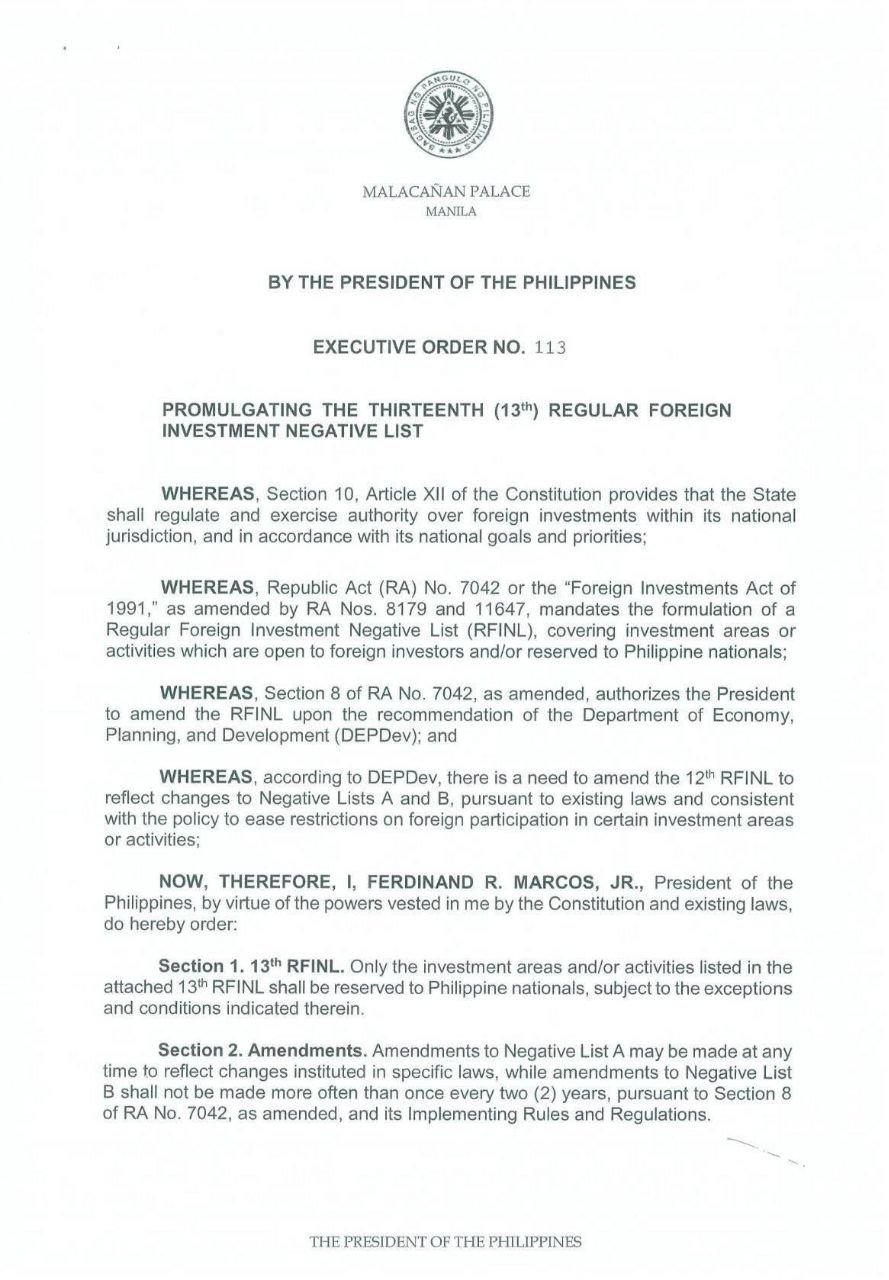
Executive Order No. 113, establishing the 13th Regular Foreign Investment Negative List (RFINL), has been signed by President Ferdinand Marcos Jr., introducing updated foreign ownership parameters for multiple Philippine economic sectors. The directive, dated April 13, 2026, becomes effective 15 days following its publication in the Official Gazette or a newspaper with general circulation.
Malacañang Palace’s official documentation indicates that both Negative Lists A and B undergo modifications under this order, aligning with current legislation while supporting the administration’s initiative to reduce foreign investment barriers in selected areas and activities.
The Department of Economy, Planning, and Development (DEPDev) recommended the executive order’s issuance, emphasizing the necessity to update the 12th RFINL according to present regulatory standards.
Legal Foundation and Authority
Republic Act No. 7042, the “Foreign Investments Act of 1991,” as modified by RA Nos. 8179 and 11647, mandates the Foreign Investment Negative List’s creation. This law requires establishing a comprehensive list detailing investment sectors accessible to foreign investors or restricted to Filipino nationals.
Constitutional Article XII, Section 10 empowers the State to regulate foreign investments within national boundaries according to established goals and priorities. Under RA No. 7042, Section 8, the President holds authority to modify the RFINL based on DEPDev recommendations.
Sectors with Total Foreign Ownership Prohibition
List A encompasses sectors where constitutional provisions and specific legislation limit foreign ownership. Ten sectors maintain absolute foreign equity prohibition, including mass media operations, excluding recording and internet business activities as specified in Department of Justice Opinion No. 40.
Architecture’s corporate practice remains exclusively Filipino, alongside cooperatives, except for former natural-born Philippine citizens’ investments. Private security agencies under RA No. 11917, the “Private Security Services Industry Act,” similarly exclude foreign ownership completely.
Small-scale mining operations under RA No. 7076, marine resource exploitation in territorial waters, and cockpit operations continue excluding foreign ownership. Nuclear, biological, chemical, and radiological weapons manufacturing, repair, stockpiling, and distribution remain off-limits to foreign investors, including firecracker and pyrotechnic device production and retail.
Sectors Permitting Restricted Foreign Investment
Multiple sectors accommodate limited foreign participation under different percentage thresholds. Private recruitment agencies for local or overseas employment allow 25 percent foreign equity maximum under Labor Code Article 27. Defense-related construction contracts share this 25 percent restriction.
Advertising services accommodate 30 percent foreign ownership under Constitutional Article XVI, Section 11(2). Various sectors permit 40 percent foreign participation, including retail trade enterprises below ₱25 million paid-up capital under RA No. 11595.
Natural resource exploration, development, and utilization typically maintain 40 percent limits, with renewable energy exceptions. DOJ Opinion No. 21 and Department of Energy Circular DC2022-11-0034 permit complete foreign participation in solar, wind, hydro, and ocean or tidal energy projects.
Educational Institutions and Public Utilities Framework
Public utility operations maintain 40 percent foreign ownership limits under Constitutional provisions and Commonwealth Act No. 146, amended by RA No. 11659. Updated public utility definitions encompass electricity distribution and transmission, petroleum pipelines, water and wastewater distribution, seaports, and public utility vehicles.
Educational institutions follow the 40 percent restriction, excluding religious group establishments, diplomatic personnel schools, and short-term skills development facilities outside formal education systems under Batas Pambansa Blg. 232.
Rice and corn production, milling, processing, and trading allow 40 percent foreign investment with divestment requirements under Presidential Decree No. 194 and NFA Council Resolution No. 193.
Infrastructure and Procurement Guidelines
Government procurement covering goods, infrastructure, and consulting services generally permits 40 percent foreign participation. Infrastructure projects requiring unavailable Filipino techniques or technologies may accommodate 75 percent foreign ownership.
Foreign bidder qualification depends on treaty arrangements, home country reciprocal rights, local supplier unavailability, or competitive requirements outlined in RA No. 12009 implementing rules, the “New Government Procurement Act.”
Defense and Security Regulations
List B addresses sectors regulated for security, defense, health, moral, and small enterprise protection purposes. Firearms, explosives, and related materials manufacturing, repair, storage, and distribution require Philippine National Police clearance with 40 percent foreign ownership limits.
Defense materiel development, production, and manufacturing under RA No. 12024 maintain 40 percent restrictions, including dangerous drug distribution and manufacturing authorized under RA No. 9165.
Telecommunications Special Provisions
Telecommunications operations allow complete foreign equity when investors’ home countries provide reciprocal treatment to Philippine nationals. Without reciprocity, foreign ownership caps at 50 percent under RA No. 11659.
Small Enterprise Safeguards
Micro and small domestic market enterprises with paid-in equity below US$200,000 equivalent maintain 40 percent foreign ownership limits. Advanced technology startups with lead agency endorsement or enterprises employing majority Filipino workers with capital below US$100,000 face similar restrictions.
The executive order provides amendment procedures, allowing Negative List A changes anytime reflecting specific law modifications, while Negative List B amendments cannot exceed once every two years per statutory requirements.
Photo credit: Photo courtesy of Malacañang Palace