Standfirst: PhilHealth pays a different amount depending on what kind of facility you deliver in. The gap between a hospital and a non-hospital birthing facility is about ₱15,000, and most families only find out at discharge.
Figures are PhilHealth’s published case rates. Verify your own facility’s current accreditation and your membership status before you deliver — both are checkable in advance.
The two rates
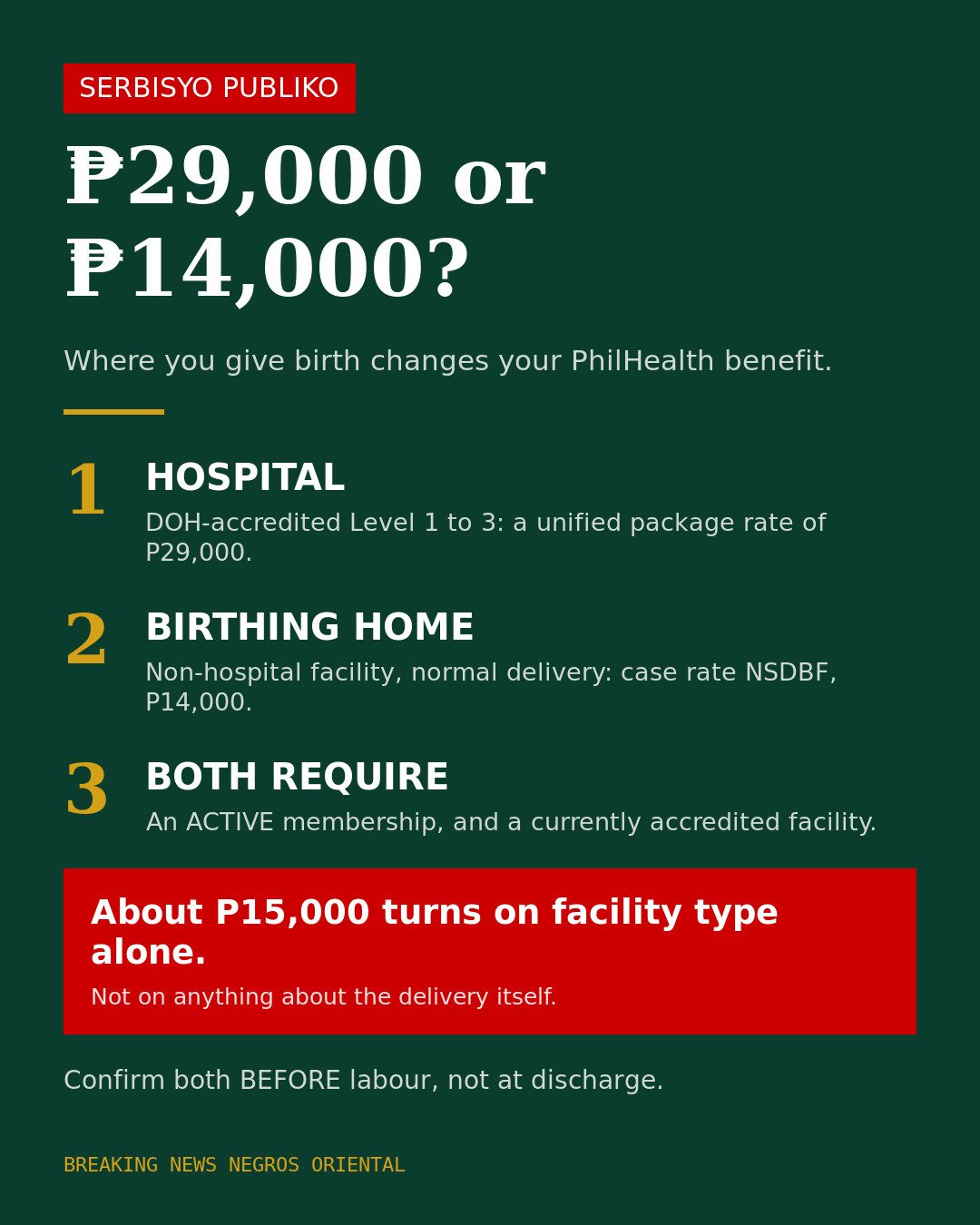
In a DOH-accredited hospital, Level 1 to Level 3, PhilHealth applies a single unified package rate of ₱29,000 for giving birth. Level 1 is a basic community hospital; Level 3 is a major medical centre. The package rate is the same across those levels.
In a non-hospital birthing facility — a birthing home or lying-in clinic — a normal spontaneous delivery is paid under benefit code NSDBF at a case rate of ₱14,000.
That is roughly a ₱15,000 difference, decided by the type of facility rather than by anything about the delivery itself.
This is not an argument for choosing one over the other. A birthing home close to home may be the right choice for a straightforward pregnancy, and proximity matters in labour. But the money should be a known quantity beforehand, not a surprise.
Two things must both be true for the benefit to apply
Your membership must be active at the time you deliver. A lapsed or inactive record at the moment of admission is one of the most common reasons a claim fails.
The facility must be PhilHealth-accredited, so the case rate is deducted automatically from your bill. If it is not accredited, the benefit is not applied — regardless of the facility being licensed and perfectly legitimate.
Birthing homes and lying-in clinics: the licence rule
Since 2018, every birthing home and maternity or lying-in clinic must hold a valid DOH License to Operate as a prerequisite for PhilHealth accreditation — for initial accreditation, renewal and re-accreditation alike.
So for this category the question is genuinely two questions: does it hold a current DOH LTO, and is it currently accredited by PhilHealth. The first does not guarantee the second.
What to settle before you are in labour
- Confirm the facility’s accreditation is current — on PhilHealth’s published list, not from a certificate on the wall
- Confirm your membership is active, and that your contributions are recorded against the right member record
- Ask whether the case rate is deducted at discharge or claimed afterwards, and what documents you must bring
- Know the difference in your own case — if you are choosing between a hospital and a birthing home, the ₱29,000 versus ₱14,000 gap is part of the decision
- Have a plan for referral. A birthing facility that has to transfer you mid-labour changes both the clinical picture and the claim
Where to check
PhilHealth publishes its accredited health facilities list at philhealth.gov.ph under Partners, and its maternity benefit rules and circulars on the same site. The Department of Health’s Health Facilities and Services Regulatory Bureau publishes licensed facilities at hfsrb.doh.gov.ph.
Our separate guide explains why a DOH licence and PhilHealth accreditation are not the same approval, and how to check each.
Sources: PhilHealth published case rates for maternity care, including the unified ₱29,000 package for DOH-accredited Level 1–3 hospitals and the ₱14,000 NSDBF case rate for non-hospital birthing facilities; PhilHealth Circular No. 2018-0002 on the DOH License to Operate as a mandatory requirement for accreditation of birthing homes and maternity/lying-in clinics; Department of Health Health Facilities and Services Regulatory Bureau.
Related stories