Standfirst: The two are separate approvals from two different agencies, and a clinic can hold one without the other. Turning up with the wrong assumption is how a bill you expected PhilHealth to absorb lands on you in full.
This explains how to check. We do not name or rank clinics — accreditation status changes, and the only current answer is the one on the official lists below.
Two different approvals, two different agencies
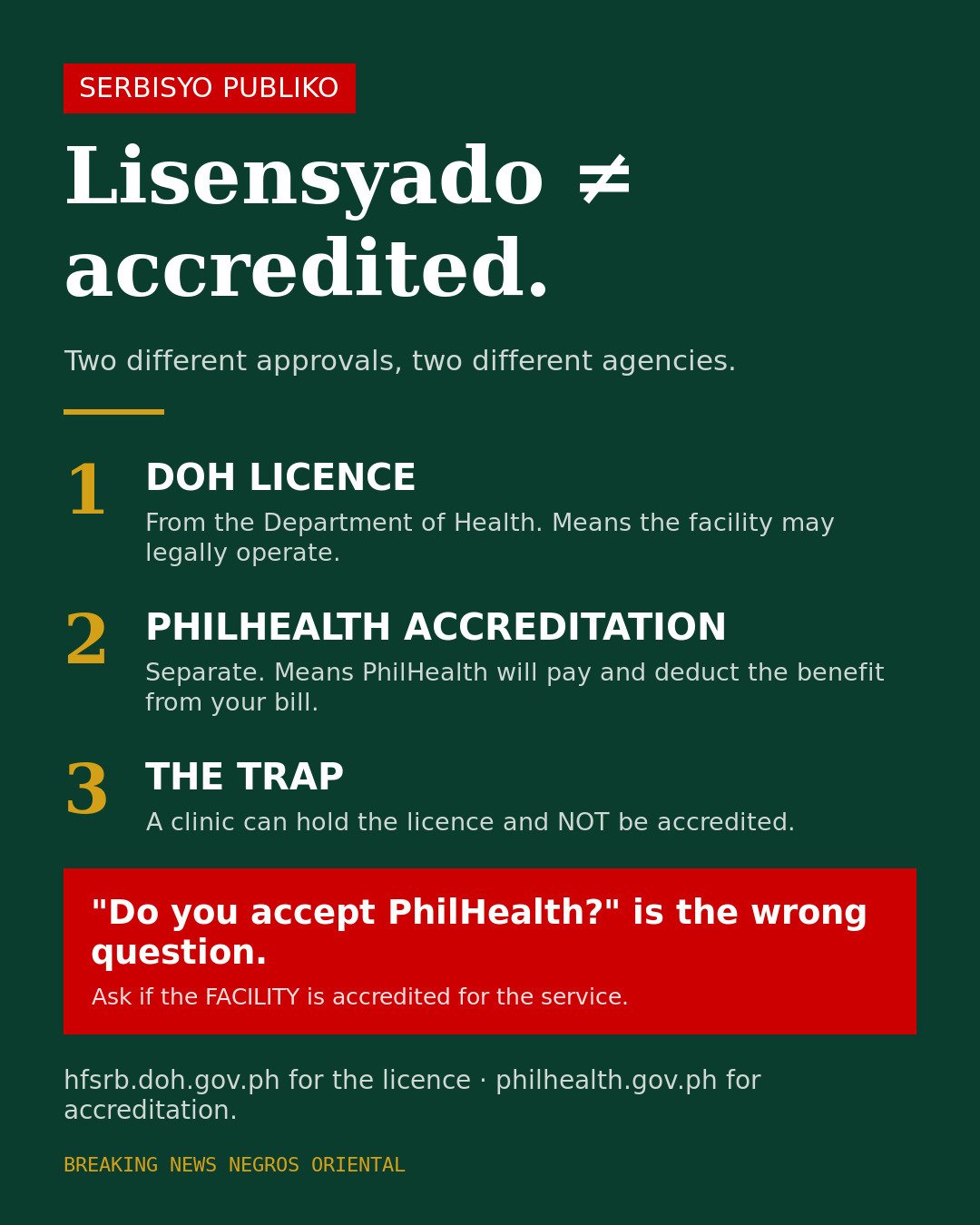
A DOH License to Operate (LTO) is issued by the Department of Health, through its Health Facilities and Services Regulatory Bureau. It means the facility is legally permitted to operate and has met regulatory standards for its type.
PhilHealth accreditation is separate. It is PhilHealth’s own formal recognition that a facility meets its standards for participation in the programme. Accredited facilities can provide services PhilHealth will cover, and can usually deduct the benefit from your bill directly.
The LTO is a prerequisite for accreditation, not a substitute for it. A facility can be perfectly legal and still not be accredited — in which case PhilHealth does not pay, and nothing is deducted at the counter.
The assumption that costs people money
The common mistake is to treat any of these as proof of coverage:
- The clinic has a DOH licence displayed
- The doctor says they accept PhilHealth
- The clinic accepted your PhilHealth number
None of those establish that the facility is accredited. A physician accepting PhilHealth and a facility being accredited for facility benefits are different things, and it is the facility status that determines whether the case rate is deducted from your bill.
How to check, before you need it
For the facility’s DOH licence — the Health Facilities and Services Regulatory Bureau publishes a list of licensed health facilities and services at hfsrb.doh.gov.ph.
For PhilHealth accreditation — PhilHealth publishes its list of accredited health facilities at philhealth.gov.ph, under Partners. Accreditation covers hospitals, hospital extension facilities, infirmaries, ambulatory surgical clinics, freestanding dialysis clinics and other specialty providers, each accredited for particular services.
For the individual doctor — the Professional Regulation Commission maintains verification of registered professionals. A physician’s PRC registration is about the person’s licence to practise; it says nothing about whether the facility is accredited.
Ask directly, and ask precisely. “Are you PhilHealth accredited?” can be answered loosely. Better: “Is this facility currently accredited by PhilHealth for the service I need, and will the case rate be deducted from my bill?” The second question is harder to answer vaguely.
What to check before a planned admission
- The facility appears on the current PhilHealth accredited list, not a screenshot or an old certificate on the wall
- Accreditation covers the specific service you need — accreditation is granted per facility type and service, not as a blanket
- Your own PhilHealth membership is active at the time of admission
- You know whether the benefit will be deducted at discharge or claimed afterwards
If it turns out not to be accredited
That does not make the facility unsafe or illegitimate — a DOH licence is the safety and standards approval. It means the cost is yours, and you should know that before admission rather than at discharge.
For anything planned, checking takes minutes. For an emergency, you go to the nearest facility that can treat you and sort the paperwork later; the checking above is for the decisions you make in advance.
Sources: Department of Health Health Facilities and Services Regulatory Bureau (hfsrb.doh.gov.ph) — licensing and the published list of licensed facilities; PhilHealth (philhealth.gov.ph) — accreditation process, requirements and the published list of accredited health facilities; Professional Regulation Commission — verification of registered professionals.
Related stories