
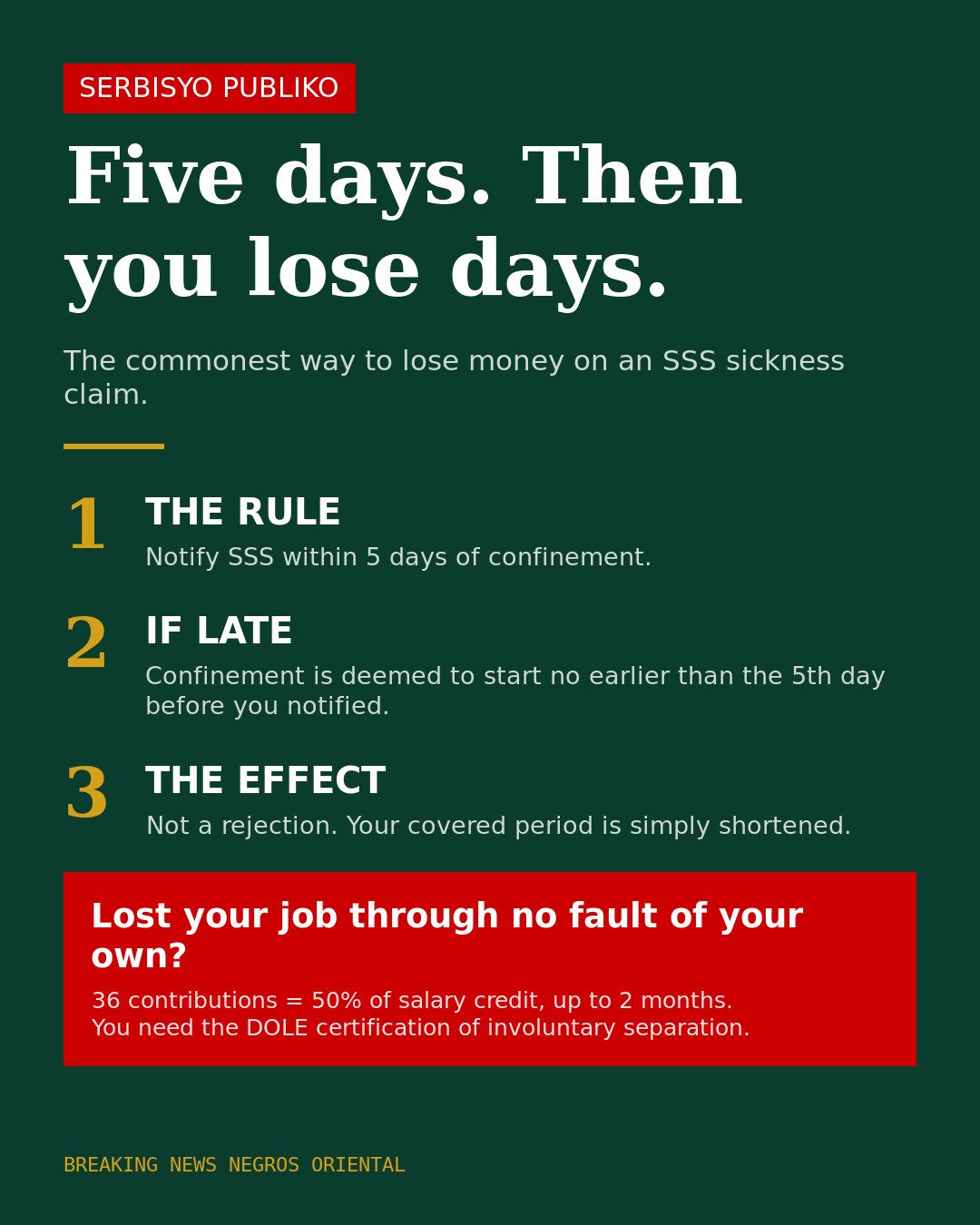
Standfirst: The most common way to lose money on an SSS sickness claim is not a rejection. It is a late notification, which quietly moves the start of your covered period forward and shortens what you are paid for.
This covers the notification and eligibility rules that trip people up. Contribution counts and amounts depend on your record — confirm yours with SSS.
The five-day rule, and what late filing actually does
If a member notifies SSS beyond the prescribed five-day period, the confinement is deemed to have started not earlier than the fifth day immediately preceding the date of notification.
Read that carefully, because it is not a rejection and it is not a fine. It re-dates your confinement. Days of genuine illness before that window simply stop counting, and the benefit shrinks accordingly.
If you are employed, notification normally runs through your employer. If you are self-employed or a voluntary member, it is on you. Either way the clock is the same, and it starts at confinement — not at recovery, and not at the point you feel well enough to deal with paperwork.
The limits on sickness benefit
- A maximum of 120 days in one calendar year
- Not more than 240 days on account of the same illness
The second cap is the one that matters for a long-running condition, and it runs across calendar years.
Maternity: 105 days, and the additions
The SSS maternity benefit grants 105 days of paid maternity leave for live childbirth, regardless of the mode of delivery — normal or caesarean makes no difference to the entitlement.
- An additional 15 days where the member qualifies as a solo parent under the Solo Parent Welfare Act
- 60 days in the case of miscarriage or emergency termination of pregnancy
“Regardless of the mode of delivery” is worth knowing because it is a common misunderstanding that a caesarean earns more leave. It does not — the leave is the same, though the PhilHealth case rate for the delivery is separate and does differ.
The benefit most people do not know exists
Unemployment benefit. If you lose your job through no fault of your own and have at least 36 contributions, SSS pays a cash grant of 50 percent of your average monthly salary credit for up to two months.
It requires a DOLE certification of involuntary separation — that document is the pivot of the whole claim, and it is obtained from the Department of Labor and Employment, not from SSS.
Retrenchment, redundancy, closure and authorised causes generally qualify. Resignation does not.
What to do at the point it matters
- Notify within five days of confinement. Not after. This is the single highest-value action in this article.
- If separated from work, ask for the DOLE certification immediately, while the employer’s records and contacts are still fresh
- Check your contribution count before you need it — eligibility for most benefits turns on it
- Keep your member record current, especially your civil status and beneficiaries
Where to check
SSS publishes benefit rules, qualifying conditions and filing procedures at sss.gov.ph, and member records are viewable through My.SSS. Because qualifying contribution counts and salary credits change by circular, confirm your own figures rather than relying on a number you were quoted previously.
Sources: Social Security System published benefit rules — sickness benefit notification period and its effect on the reckoned start of confinement, the 120-day annual and 240-day same-illness limits; maternity benefit of 105 days for live childbirth regardless of delivery mode, 15 additional days for qualified solo parents under the Solo Parent Welfare Act, and 60 days for miscarriage or emergency termination; unemployment benefit conditions including involuntary separation, the 36-contribution requirement, 50 percent of average monthly salary credit for up to two months, and the DOLE certification requirement.
Related stories