
MANILA — President Ferdinand R. Marcos Jr. signed Republic Act No. 12316 into law on March 25, 2026, granting the President the authority to temporarily suspend or reduce excise taxes on petroleum products during periods of high global oil prices. The move aims to protect consumers and stabilize the Philippine economy amid ongoing volatility in world energy markets.
The new measure amends Section 148 of the National Internal Revenue Code of 1997. It enables the executive branch to intervene when crude oil prices surge, particularly during geopolitical tensions or supply disruptions that could drive inflation higher.
Conditions for Suspending or Reducing Fuel Excise Tax
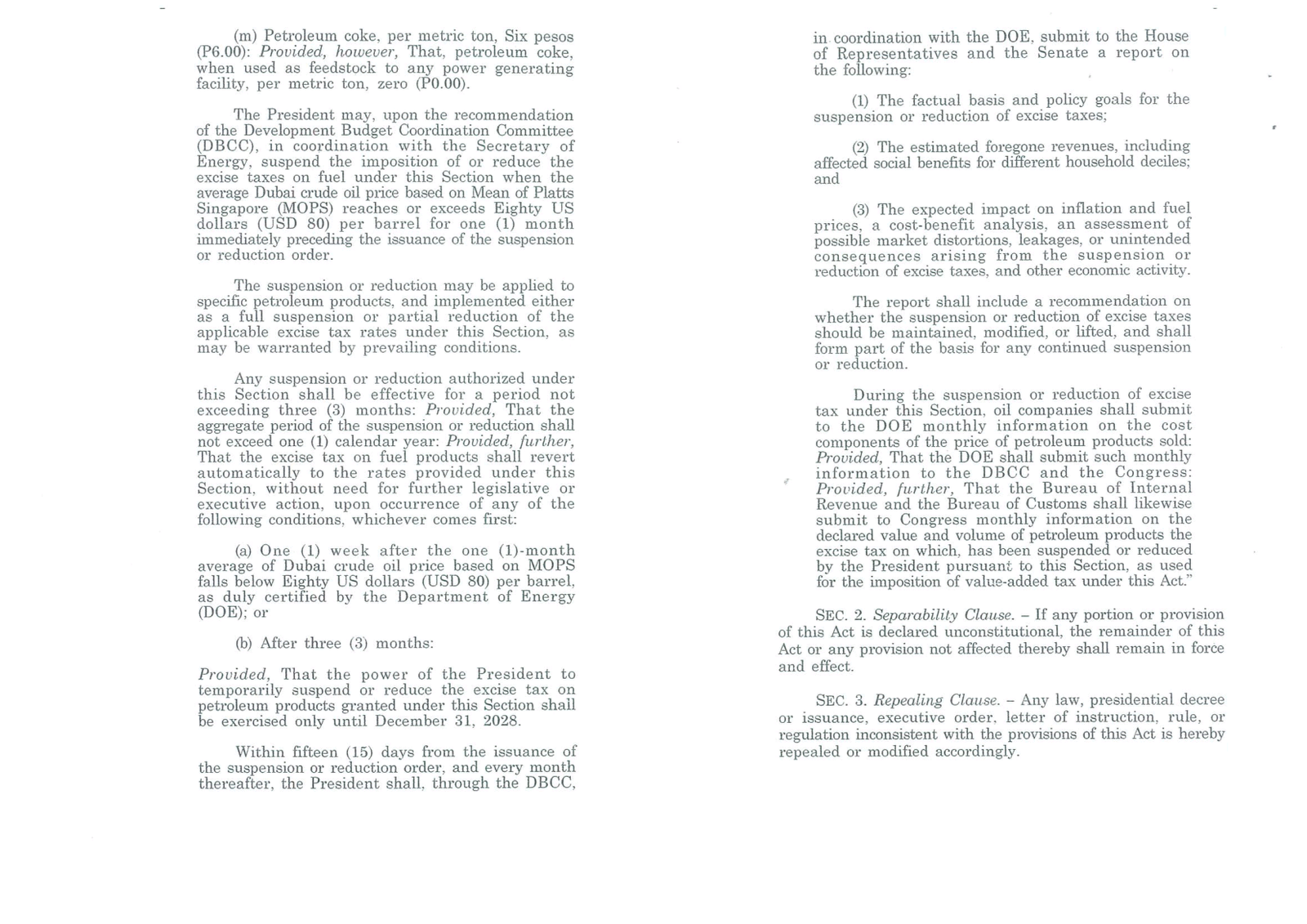
Under Republic Act No. 12316, the President can only suspend or reduce excise taxes on fuel upon recommendation of the Development Budget Coordination Committee (DBCC) and in coordination with the Department of Energy. The authority can only be utilized if the average price of Dubai crude oil, based on the Mean of Platts Singapore (MOPS), reaches or exceeds 80 U.S. dollars per barrel for one month prior to the issuance of the order.
Government officials emphasized that this threshold ensures the tax relief mechanism is only used during significant market stress, preventing it from becoming a routine policy tool.
Government Aims to Cushion Impact on Consumers
A senior economic official stated that the law provides the government with the flexibility to respond swiftly to extraordinary increases in global oil prices without the need for a lengthy legislative process. The intention is to cushion the impact of high fuel prices on transportation costs, food prices, and the cost of basic commodities for Filipino consumers.
Fuel excise taxes were increased in 2018 under the Tax Reform for Acceleration and Inclusion (TRAIN) law. While the revenues generated from the TRAIN law helped fund infrastructure and social programs, the increase drew criticism during periods of rising oil prices. Supporters of the new measure argued that the country requires a built-in safety mechanism to prevent sudden spikes in fuel costs from triggering broader inflation across the economy.
Scope and Duration of Suspension Under the New Law
Republic Act No. 12316 permits the suspension or reduction of excise taxes to be applied either fully or partially, and only to specific petroleum products if deemed necessary. The law also sets limits on the duration the tax relief can remain in effect. Each suspension order can last for a maximum of three months, and the total period of suspension or reduction cannot exceed one year.
The legislation stipulates that the excise tax will automatically return to its original rate if oil prices fall below the 80-dollar threshold or once the allowed suspension period expires.
Presidential Authority Limited to December 2028
The President’s authority to utilize the tax suspension power is temporary. The law specifies that the provision will only remain valid until December 31, 2028. To extend this authority beyond that date, Congress would need to pass a new measure.
Strict Reporting Requirements to Ensure Oversight
The new law contains strict reporting requirements to ensure Congressional oversight. Within fifteen days of issuing an order to suspend or reduce excise taxes, and every month thereafter, the President must submit a report to both houses of Congress. The report must explain the factual basis for the decision, the anticipated loss in government revenue, and the projected impact on inflation, fuel prices, and overall economic activity.
The report must also include a cost-benefit analysis and an assessment of possible market distortions or unintended consequences that may result from lowering fuel taxes.
Oil Companies Required to Submit Cost Component Reports
Oil companies are now required to provide monthly reports to the Department of Energy (DOE) detailing the cost components of petroleum products sold in the market. The DOE is then responsible for forwarding this information to the DBCC and Congress. Additionally, the Bureau of Internal Revenue (BIR) and the Bureau of Customs are required to submit data on the volume and declared value of petroleum products affected by the tax suspension.
Supporters of Republic Act No. 12316 have stated that these monitoring provisions are necessary to ensure that any tax relief granted by the government will directly benefit consumers and not simply increase the profits of oil companies operating in the Philippines.
Dependence on Fuel Imports Exposes Philippines to Price Shocks
Economic analysts have pointed out that the Philippines remains heavily dependent on imported fuel, which makes the country particularly vulnerable to global price shocks caused by international conflicts, supply disruptions, or production cuts by major oil-producing nations. Concerns about instability in the Middle East and tightening supply in global markets have recently renewed fears of another surge in oil prices, reminiscent of previous energy crises.
Calls for Fuel Tax Suspension Amid High Prices
Transportation groups and consumer advocates have consistently called on the government to suspend fuel taxes during periods of high prices. They argue that rising diesel and gasoline costs quickly translate into higher fares for public transportation, increased food prices, and higher electricity rates, placing a burden on ordinary Filipino citizens.
Business groups, however, have cautioned that removing excise taxes could reduce government revenues needed to fund essential infrastructure projects, social services, and subsidies. They emphasize the importance of limiting the use of the tax suspension authority to truly exceptional circumstances to protect the national budget.
Law Takes Effect Fifteen Days After Publication
Republic Act No. 12316 will take effect fifteen days after its publication in the Official Gazette or in a newspaper of general circulation within the Philippines.
Government officials have clarified that the new law does not automatically reduce fuel prices immediately. Instead, it provides the government with a crucial tool that can be used if global oil prices continue to rise sharply, threatening the economic stability of the country.
With Republic Act No. 12316 now in effect, the current administration believes it is better equipped to respond swiftly should another energy crisis arise, helping to prevent inflation from spiraling out of control and placing further pressure on Filipino households.
Photo credit: Photo from Official Gazette