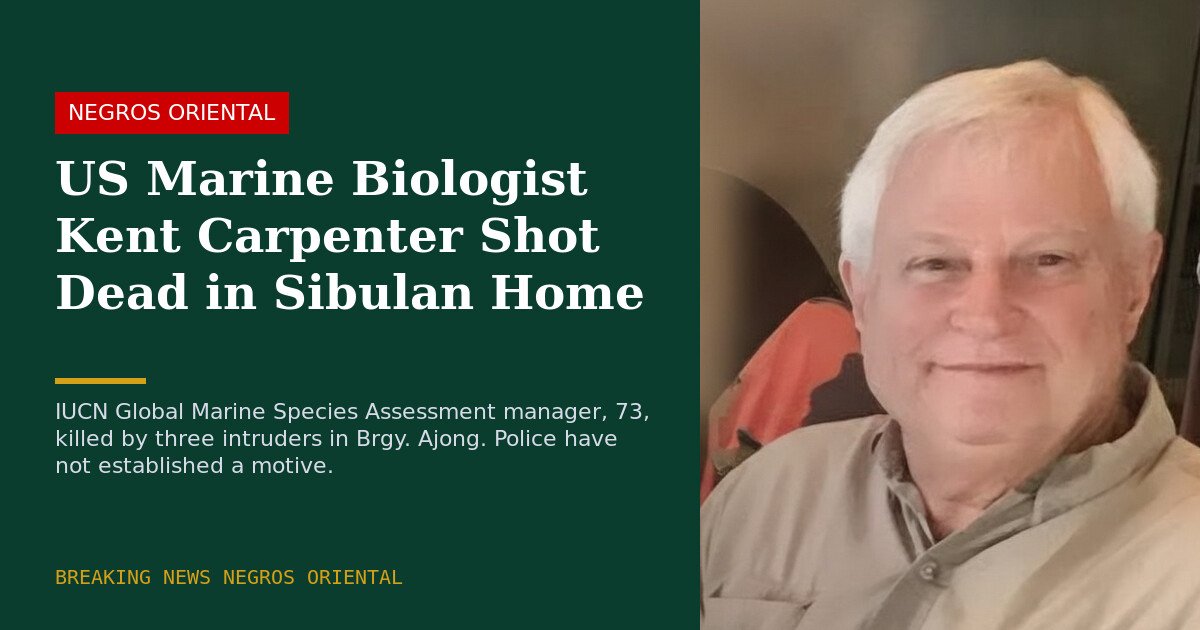
A celebrated American scientist who devoted more than half a century to studying Philippine marine ecosystems was fatally shot inside his home in Barangay Ajong, Sibulan, Negros Oriental, late on the night of July 12 — a killing that has sent shockwaves through the global scientific and conservation community.
How the Attack Unfolded
Kent Edward Carpenter, 73, was in his living room watching television alongside his 34-year-old Filipina companion at approximately 11:30 p.m. when three unidentified men forced their way into the residence in Purok 3, Barangay Ajong. According to police, one of the intruders produced a handgun and fired a single shot to Carpenter’s head. All three suspects fled the premises immediately following the attack.
Authorities were alerted after a concerned citizen reported the incident. The Police Regional Office-Negros Island Region noted in a statement issued Tuesday that initial reports on the condition of Carpenter’s companion varied; she was injured and was undergoing both medical treatment and forensic examination as of that statement’s release.
Investigation Underway, Suspects Still at Large
The Police Regional Office-Negros Island Region confirmed in its Tuesday statement that the three perpetrators have not yet been apprehended and that investigators have yet to establish a clear motive for the killing. Regional police authorities activated a Special Investigation Task Group on the morning of July 14 to focus exclusively on identifying and capturing those responsible for the crime.
Authorities have urged anyone with information relevant to the case to come forward and coordinate with the Sibulan Municipal Police Station or the nearest police facility in their area.
A Scientist With Deep Philippine Roots
Carpenter’s connection to the Philippines was one of the defining threads of his professional life. According to Silliman University records, his first assignment to the country came in 1975 when he joined the United States Peace Corps, remaining here until 1978 and leading coral reef research for the Bureau of Fisheries and Aquatic Resources. That initial immersion would grow into a lifelong dedication spanning more than 50 years of active research.
At the time of his death, Carpenter held the position of Professor and Eminent Scholar in the Department of Biological Sciences at Old Dominion University in Norfolk, Virginia — a post he had occupied since 1996. He simultaneously served as the worldwide manager of the International Union for Conservation of Nature’s Global Marine Species Assessment, giving him a significant role in shaping international biodiversity frameworks.
Silliman University, where he held an adjunct professorship at its Institute of Environmental and Marine Sciences in Dumaguete City, has been among the Philippine institutions most closely associated with his research career.
Legacy: Mapping the World’s Richest Marine Zone
Among the most consequential achievements of Carpenter’s scientific career was his co-authorship of a landmark 2005 study that formally identified the Verde Island Passage as the single greatest center of marine shore fish biodiversity on the planet. That research had lasting implications for conservation planning and firmly positioned the Philippines at the center of global marine biology discourse. In recent years, Carpenter had also been actively advocating for the Verde Island Passage to be recognized as a UNESCO World Heritage Site.
His influence extended into the formal nomenclature of science itself: two fish species were named in his honor. Paracheilinus carpenteri, known commonly as Carpenter’s flasher wrasse, and Meganthias carpenteri, or Carpenter’s Yellowtop Jewelfish, stand as permanent markers of his contributions to ichthyology and Indo-Pacific reef science.
Scientific Community Mourns, Demands Accountability
Reports indicate that news of Carpenter’s death has prompted an outpouring of grief and urgent calls for justice from Filipino scientists, academic institutions, and conservation organizations across the country. His passing is widely regarded as an irreplaceable loss to the field of marine biodiversity research, particularly as it pertains to the Philippines — a nation whose extraordinary marine wealth he spent decades documenting and defending.
By the Numbers
- 73 — Carpenter’s age at the time of the shooting
- 11:30 p.m. — Approximate time of the attack on Sunday, July 12
- 3 — Number of unidentified suspects who entered the home
- 1975–1978 — Years Carpenter served in the Philippines as a Peace Corps volunteer
- 50+ years — Length of his engagement with Philippine marine research
- 2005 — Year the Verde Island Passage biodiversity study was published
- 2 — Fish species formally named in his honor
Why This Matters
The death of Kent Carpenter deprives the scientific world of one of its foremost experts on Philippine marine biodiversity — a researcher whose findings directly influenced conservation policy and elevated the Philippines’ profile in global marine science over more than five decades. With three suspects still unaccounted for and no established motive as of July 14, the case remains an active and urgent criminal investigation now being handled by a specially constituted task group. The breadth of the response from the Philippine scientific and conservation community reflects how deeply his work was valued, and how significant the loss is to ongoing research efforts in the region.
Source: Breaking News Negros Oriental / Police Regional Office-Negros Island Region statements