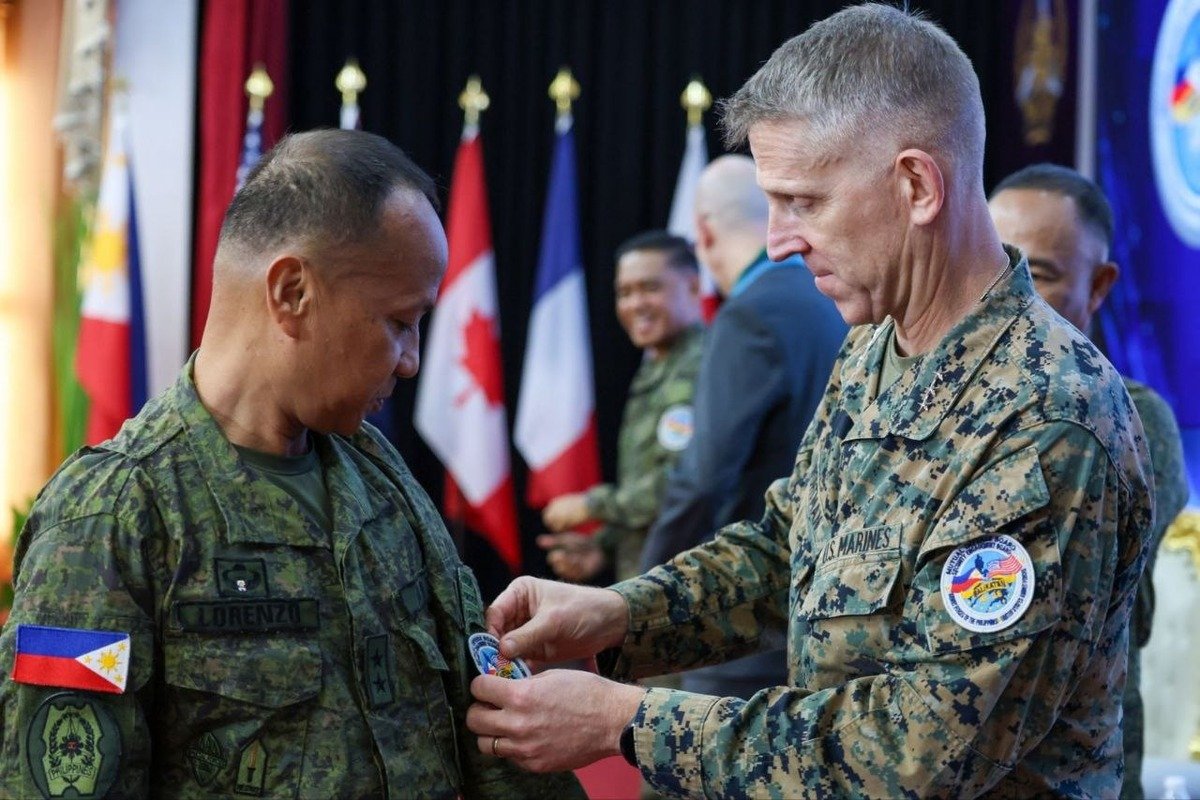
Military leaders from the Philippines and United States marked a pivotal moment in bilateral defense cooperation on Tuesday, April 21, 2026, as they ceremonially launched Exercise Balikatan 41-2026 at Camp Aguinaldo in Quezon City. This year’s iteration represents an unprecedented expansion of the annual training program, featuring the largest contingent of participants in its four-decade existence.
The ceremonial launch brought together senior officials including U.S. Chargé d’Affaires a.i. Y. Robert Ewing, Philippine Armed Forces Chief of Staff General Romeo S. Brawner Jr., U.S. I Marine Expeditionary Force Lieutenant General Christian F. Wortman, Philippine Exercise Director Major General Francisco F. Lorenzo, and AFP Deputy Chief of Staff for Operations Major General Elmer B. Suderio.
Record-Breaking Participation Numbers
Colonel Xerxes A. Trinidad of the AFP Public Affairs Office confirmed that approximately 17,000 military personnel will engage in the exercise, establishing a new participation record for the Balikatan program. This massive scale reflects the growing international commitment to collaborative security initiatives in the Indo-Pacific theater.
The exercise has transformed dramatically from its original bilateral format, now incorporating active military participation from six nations while hosting observers from 13 additional countries. This evolution demonstrates the program’s expanding role as a cornerstone of regional security cooperation.
Multinational Coalition Takes Center Stage
Australia, Canada, France, Japan, and New Zealand join the Philippines and United States as active participants in this year’s exercise, bringing diverse military capabilities and operational expertise to the training scenarios. Each partner nation contributes specialized knowledge that enhances the overall educational value and operational coordination among allied forces.
The transformation from bilateral to multilateral engagement reflects broader strategic shifts in Indo-Pacific security cooperation. Military planners view this expanded participation as essential for developing effective responses to complex regional challenges that require coordinated international action.
Through the International Observers Program, an additional 13 nations gain valuable exposure to allied training methodologies and coordination procedures. This observer framework facilitates military-to-military relationships and knowledge exchange among regional security stakeholders without requiring direct operational participation.
Strategic Vision for Regional Stability
AFP Chief of Staff General Brawner articulated the exercise’s broader strategic significance during opening ceremonies, emphasizing its role in strengthening collective defense capabilities across participating nations. His remarks positioned the training as both a practical demonstration of military readiness and a diplomatic statement of unified commitment.
“Balikatan is readiness made real, cooperation put into action, and peace preserved through strength,” General Brawner declared. “Let this exercise not only demonstrate our readiness, but affirm our commitment to stand together and to act together.”
These statements underscore the dual nature of the exercise as both a military training program and a diplomatic instrument for reinforcing alliance relationships. The scenarios are specifically designed to improve crisis response coordination and interoperability among participating forces.
Anniversary Context Adds Historical Weight
The 2026 exercise carries special historical significance as it occurs during the 75th anniversary year of the Philippines-United States Mutual Defense Treaty. This foundational agreement, established in 1951, created the legal framework for ongoing military cooperation between the two nations.
Military historians note that this anniversary timing provides important context for understanding how the bilateral relationship has evolved from post-war reconstruction support to contemporary multilateral security cooperation. The exercise demonstrates practical application of treaty principles in modern regional security challenges.
The anniversary backdrop reinforces the enduring nature of Philippines-U.S. defense cooperation while highlighting its adaptation to address evolving 21st-century security requirements through expanded partnership frameworks.
Indo-Pacific Security Architecture Development
The expanded exercise format directly supports what military officials describe as a shared commitment to maintaining “a free and open Indo-Pacific region.” This strategic concept has gained prominence as nations seek collaborative approaches to regional security challenges.
Training scenarios encompass diverse operational areas including humanitarian assistance, disaster response coordination, maritime security operations, and territorial defense planning. These focus areas reflect the multifaceted nature of contemporary security challenges in the Indo-Pacific region.
Participation from geographically diverse Indo-Pacific nations demonstrates broad international support for multilateral security cooperation. Each contributing nation brings unique regional perspectives and specialized capabilities based on their specific security experiences and strategic priorities.
Comprehensive Multi-Domain Training Approach
The 2026 iteration incorporates sophisticated training across land, sea, air, and cyber domains, reflecting contemporary military realities where conflicts span multiple operational environments simultaneously. This integrated approach prepares participants for complex scenarios requiring coordinated responses across different military domains.
Training components include joint planning exercises, combined operational scenarios, humanitarian assistance simulations, and disaster response coordination drills. This diverse training portfolio allows participating forces to practice interoperability across various mission types and operational contexts.
The substantial scale of participation enables more realistic and complex training scenarios that better simulate real-world conditions where multiple nations must coordinate rapid responses to regional crises or natural disasters requiring international assistance.
Long-term Regional Security Implications
Defense analysts interpret the expanded Balikatan format as a significant contribution to broader regional security architecture development. The exercise provides practical testing grounds for cooperation mechanisms while building trust and understanding among participating nations.
The International Observers Program particularly supports this architecture-building function by exposing additional nations to allied capabilities and operational procedures. This engagement helps develop understanding of cooperative security approaches and builds relationships for future collaboration.
Exercise outcomes are expected to inform ongoing security cooperation initiatives and provide valuable lessons for enhancing multilateral coordination throughout the Indo-Pacific region. These insights contribute to evolving efforts to strengthen regional security partnerships through practical cooperation and shared training experiences.
Photo credit: Photo courtesy of SSg Ambay PA and PFC Carmelotes PN(M) / PAOAFP
Related stories