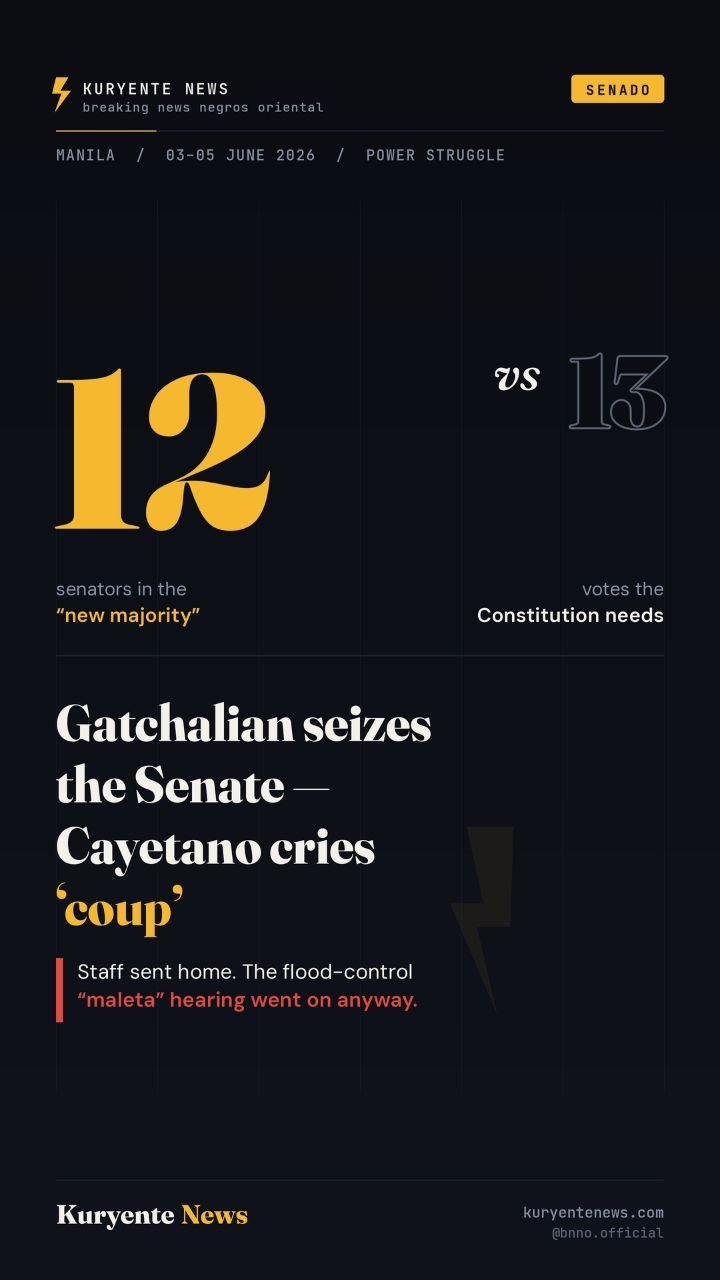
A swift and controversial leadership takeover inside the Philippine Senate has thrown the chamber into disorder, with competing memoranda, a lightning-fast adjournment, and a work-from-home directive for staff all unfolding within the first two days after a self-proclaimed “new majority” assumed control on June 3, 2026 — even as their displaced rivals continued conducting Senate business as though nothing had changed.
The dramatic turn of events has drawn widespread ridicule online and prompted serious legal warnings, with at least one retired judge cautioning that the standoff between two competing Senate authorities could end up before the Supreme Court as a full-blown constitutional crisis.
Two Missed Session Days Set the Stage
The events that culminated in the June 3 takeover were preceded by two consecutive days of Senate inaction. On both Monday, June 1, and Tuesday, June 2 — scheduled session days — the Senate plenary failed to convene. The bloc that would later declare itself the new majority had publicly blamed Senate President Alan Peter Cayetano, accusing him of neglecting his duty to call the chamber to order and leaving critical legislative work in limbo.
That narrative took a sudden reversal when June 3 arrived — the final scheduled session day before Congress’s constitutionally mandated sine die adjournment. The decisive moment came with the floor appearance of Sen. Francis “Chiz” Escudero, who had previously been considered an ally of Cayetano. His presence gave the assembling bloc 12 senators physically on the Senate floor.
Invoking the Supreme Court’s landmark precedent in Avelino v. Cuenco, the group declared that a valid quorum existed. Minority Leader Tito Sotto then moved to vacate all leadership positions — with the sole exception of the Senate presidency itself.
New Officers Installed; Gatchalian Steps Into Acting Role
In the reorganization that followed, Sen. Sherwin “Win” Gatchalian was elevated to Senate President Pro Tempore, displacing Sen. Loren Legarda from the post. Under existing Senate rules, the Pro Tempore automatically assumes the role of acting Senate president whenever the duly elected president is absent. Sen. Migz Zubiri was designated Majority Floor Leader, while Sen. Erwin Tulfo was installed as the new chair of the powerful Blue Ribbon Committee, replacing Sen. Pia Cayetano in that role.
A critical constitutional limitation, however, constrained the bloc’s reach. Formally removing Alan Peter Cayetano from the Senate presidency requires 13 votes — one more than the bloc currently commands. As a result, the Senate presidency is effectively vacant rather than transferred. Despite this, Malacañang through Press Officer Claire Castro and the House of Representatives both extended recognition to Gatchalian’s acting authority.
Cayetano refused to accept any of it. He publicly denounced the takeover as an “illegal coup d’etat,” asserting that he remains the Senate’s legitimate presiding officer. Legarda and Pia Cayetano similarly maintained they had not been validly removed, citing the absence of the constitutionally required 13-member quorum for major Senate decisions.
The Work-From-Home Memo That Backfired Online
One of Gatchalian’s first moves as acting Senate president was to issue a memorandum authorizing Senate Secretariat and Senate Proper staff to work from home on June 4. The directive cited the ongoing process of committee reorganization and the lack of scheduled official business. It also stated that the order was intended to preserve the bureaucracy’s neutrality and to protect staff safety and morale, with guarantees that employees who complied would not be penalized or considered absent without official leave.
Cayetano responded the same evening with a counter-memorandum ordering Senate premises to remain open and directing that a previously planned committee hearing proceed as scheduled. The conflicting orders left Senate employees — according to multiple media reports — caught in limbo, uncertain which memo carried legitimate authority and which leadership to follow.
The optics were immediately seized upon by online critics. Commentators pointed out the glaring irony: the same bloc that had spent days publicly condemning Cayetano for stalling “the people’s business” had, within hours of gaining power, adjourned the Senate sine die and sent its own staff home — all while the group it displaced pushed forward with the very hearing the new majority had sought to cancel.
Cayetano Bloc Pushes Through Blue Ribbon Flood-Control Hearing
Undeterred by the competing directives and the Gatchalian bloc’s declaration of adjournment, the Pia Cayetano-led panel convened a Blue Ribbon Committee hearing on the morning of June 4. Sen. Rodante Marcoleta presided over the session, with Sens. Robinhood Padilla and Imee Marcos also present.
Interior Secretary Jonvic Remulla was reported to have positioned himself at the lobby entrance in what appeared to be an effort to block access to the hearing, sparking a confrontation at the venue. Tulfo’s camp dismissed the session as illegitimate and announced that their version of the Blue Ribbon hearing would be held separately on June 8.
At the core of the June 4 hearing were 18 former Marines and soldiers represented by attorney Levito “Levi” Baligod. The group submitted a consolidated affidavit alleging they had served as drivers, security personnel, and couriers — referred to in testimony as “bagmen” — for fugitive former Ako Bicol Rep. Elizaldy “Zaldy” Co. According to the affidavit, they transported cash-packed luggage, called “maletas,” allegedly amounting to approximately ₱805 billion in flood-control kickbacks, with deliveries made to private homes, the House of Representatives compound, and a Forbes Park townhouse.
Affidavit Implicates Wide List of Senior Figures
The consolidated affidavit, as presented during the June 4 hearing, names an extensive roster of alleged cash recipients linked to Co’s operations. Among those named are President Ferdinand Marcos Jr., First Lady Liza Marcos, presidential son and Ilocos Norte Rep. Sandro Marcos, former House Speaker Martin Romualdez, Sens. Tito Sotto and Erwin Tulfo, and House members including Leila de Lima, France Castro, Terry Ridon, Gerville Luistro, Benny Abante, Zia Adiong, Jose Alvarez, Ace Barbers, Joel Chua, Janette Garin, Dan Fernandez, and Stella Quimbo, as well as priest Fr. Flavie Villanueva.
Every allegation in the affidavit remains unproven. Each person named has categorically denied the claims, with many describing them as fabricated, “recycled,” and politically driven. Several of those named have announced plans to file libel and perjury cases against the witnesses, according to reports from multiple news outlets covering the hearing. Sotto specifically highlighted what he described as inconsistencies in the affidavit regarding the alleged per-suitcase cash amounts, while critics have further noted that the document names both administration allies and long-standing government critics — including at least one legislator not in office during portions of the alleged period.
NBI Chief Flags Allegation That Witnesses Received ₱5 Million Each
National Bureau of Investigation Director Melvin Matibag disclosed on June 4 that he had received information alleging that former Anakalusugan Rep. Mike Defensor paid each of the 18 witnesses the sum of ₱5 million to produce their testimony, according to media reports from the same day. That allegation, like those in the affidavit itself, has not been independently corroborated as of this writing. The Philippine Navy has separately challenged the credibility of several of the 18 individuals, with earlier statements questioning whether a number of them possessed genuine service records as Marines.
Retired Judge Warns of Supreme Court Collision Course
Retired Judge Meinrado Paredes issued a public warning that the dueling claims of Senate authority — with Cayetano refusing to recognize the Gatchalian bloc’s legitimacy while the new majority presses forward regardless — carry a serious risk of escalating into a constitutional crisis that lands before the Supreme Court. Legal observers have noted that with both sides refusing to stand down, the institutional conflict shows little sign of resolution through internal Senate mechanisms alone.
As of the close of the June 4 session, two Senate leaderships were effectively operating in parallel, issuing competing orders and holding competing hearings — leaving staff, the public, and even allied institutions uncertain which body carries the authority of the Philippine Senate.
Originally reported by: wire reports
Related stories