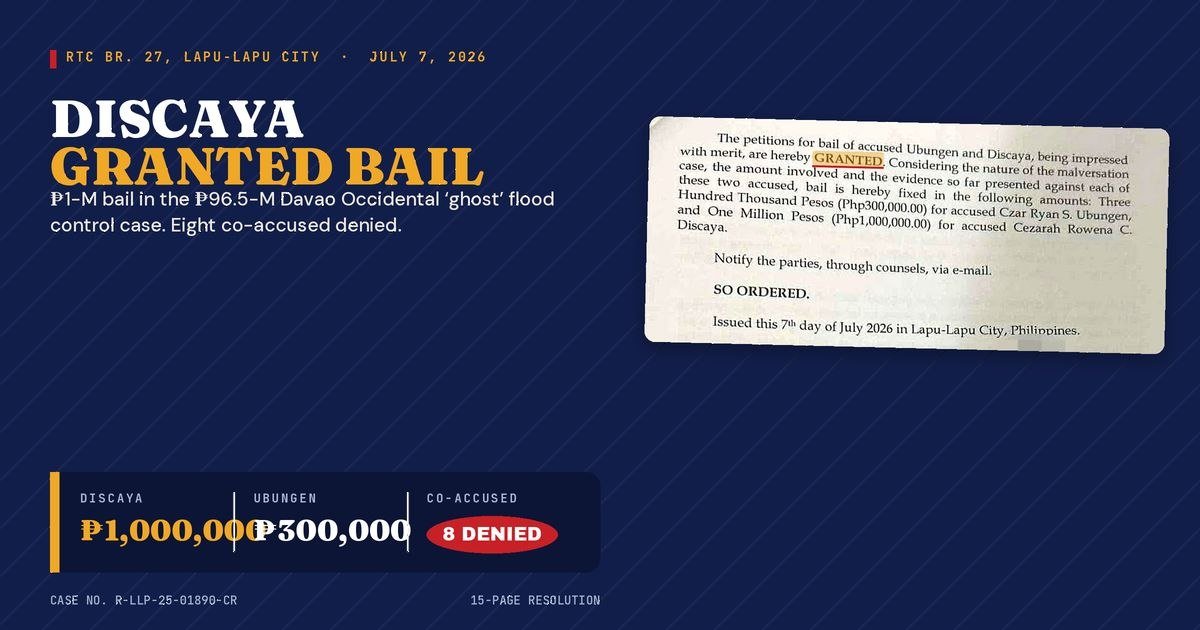
A Cebu-based regional trial court has allowed a contractor linked to an allegedly fictitious flood control project in Davao Occidental to post bail, finding that the evidence presented so far falls short of establishing her personal involvement in the scheme that prosecutors say drained ₱96.5 million in government money.
The July 7, 2026 resolution — spanning 15 pages and signed by RTC Branch 27 Presiding Judge Nelson G. Leyco — set bail at ₱1 million for Cezarah Rowena “Sarah” C. Discaya, identified as the beneficial owner of St. Timothy Construction Corporation, the firm that was awarded the flood control contract. The ruling was issued by a Lapu-Lapu City court specially designated by the Supreme Court to handle infrastructure corruption cases.
Finance Official Also Granted Provisional Liberty
Alongside Discaya, the court also extended bail to Czar Ryan S. Ubungen, who serves as acting chief of the finance section of the Department of Public Works and Highways (DPWH) Davao Occidental District Engineering Office. Judge Leyco fixed Ubungen’s bail at ₱300,000, a lower amount reflecting the court’s assessment of the evidence against him.
In its resolution, the court stated that the petitions of both Ubungen and Discaya were “impressed with merit,” taking into account the nature of the charges, the total amount allegedly misappropriated, and the state of the evidence at the bail hearing stage. Because the malversation charge — docketed as Case No. R-LLP-25-01890-CR — involves a sum large enough to make the offense ordinarily non-bailable under Philippine law, all the accused were required to file individual petitions seeking temporary liberty.
The case charges all the accused with malversation of public funds or property through falsification under Article 217 of the Revised Penal Code, in relation to Articles 171 and 172 of the same code, according to court records.
Prosecution Evidence Deemed Insufficient to Tie Discaya to Scheme
Central to the court’s decision to grant Discaya bail was its finding that the prosecution had not yet demonstrated her active and personal participation in falsifying project documents or in conspiring with her co-accused. Judge Leyco’s resolution noted that the evidence the prosecution highlighted was “not yet enough to prove Discaya’s instrumental participation” in the alleged fraud.
Notably, no witness who testified during the bail hearing was able to speak to Discaya’s direct role in the Davao Occidental project. According to the court resolution, one prosecution witness who had previously worked for St. Timothy Construction openly admitted having no personal knowledge of Discaya’s involvement in the transactions at issue.
A similar reasoning was applied to Ubungen. The court observed that the accusations against him are grounded largely in his signatures on disbursement vouchers — not on the falsified project certifications that lie at the core of the malversation case.
Eight Others Remain Behind Bars After Bail Petitions Rejected
The same resolution that freed Discaya and Ubungen on bail denied identical petitions filed by eight other co-accused, with Judge Leyco finding that the evidence against them was strong enough to warrant continued detention pending full trial.
Among those who were denied bail, according to the court resolution, are: District Engineer Rodrigo C. Larete; Assistant District Engineer Michael P. Awa; Joel M. Lumogdang, officer-in-charge of the construction section; Harold John E. Villaver, project engineer; Jafel C. Faunillan, OIC of the quality assurance section; Josephine C. Valdez, chief of the planning and design section; and Ranulfo A. Flores, chief of the maintenance section.
Also denied bail was Ma. Roma Angeline D. Rimando, the authorized managing officer of St. Timothy Construction, who has been widely identified in earlier reports as the company’s president. The court found that these eight accused had signed false certifications and supporting documents that enabled the disbursement of public funds for a project that investigators say was never carried out.
How a ₱96.5-Million Ghost Project Went Undetected
According to the Office of the Ombudsman, which filed the malversation and graft charges in December 2025, the flood control project in Davao Occidental was contracted out to St. Timothy Construction Corporation in January 2022 and was officially certified as complete in October of that same year. Government investigators who later examined the project site concluded that no actual construction work had been done on the ground.
Despite the absence of any physical project, documents were processed and payments were released as if the work had been properly delivered — resulting in the alleged misuse of ₱96.5 million in public funds, the Ombudsman stated. All the accused, including Discaya and Rimando, entered pleas of not guilty at their arraignment before Branch 27 in January 2026. They had been taken into custody at the Lapu-Lapu City Jail in December 2025 following the issuance of arrest warrants.
The case was originally filed before the Digos Regional Trial Court before being reassigned to Lapu-Lapu City. In April 2026, the Supreme Court sitting en banc dismissed Discaya’s earlier petition for certiorari, in which she had challenged the Ombudsman’s finding of probable cause; the high court ruled the petition had become moot.
Discaya Still Faces Separate Cases in Bulacan and Tax Court
The bail grant does not immediately result in Discaya’s release from detention. She faces a separate non-bailable case in Bulacan filed against her and her husband, Pacifico “Curlee” Discaya. On another front, she is also contesting four counts of tax evasion before the Court of Tax Appeals for alleged violations of Sections 254 and 255 of the National Internal Revenue Code.
Counsel for the eight co-accused whose bail petitions were denied said they were disappointed with the court’s ruling and are currently weighing their legal options, which include filing a motion for reconsideration and, if that fails, elevating the matter through a petition for certiorari. They said their clients remain confident in the defense they plan to present at full trial. Counsel for Discaya, for its part, declined to issue any comment on the resolution.
All accused continue to deny the allegations levelled against them. With the bail stage now concluded, the malversation case is set to proceed to full trial, where a complete body of evidence — far beyond the preliminary showing required at bail hearings — will be weighed by the court.
By the Numbers
- ₱96.5 million — public funds allegedly paid out for the ghost flood control project in Davao Occidental
- ₱1 million — bail amount fixed by the court for contractor Sarah Discaya
- ₱300,000 — bail amount fixed for DPWH finance official Czar Ryan Ubungen
- 8 — co-accused whose bail petitions were denied, keeping them in detention
- 15 pages — length of the court’s bail resolution dated July 7, 2026
- 4 counts — separate tax evasion charges facing Discaya before the Court of Tax Appeals
- January 2022 — when the flood control project was awarded to St. Timothy Construction
- October 2022 — when the project was falsely certified as having been completed
Why This Matters
The alleged ghost project represents a significant case of potential public funds misuse — ₱96.5 million disbursed for infrastructure that government investigators say was never built, exposing serious gaps in project oversight and certification processes within the DPWH. The court’s divided ruling, granting bail to two of the ten accused while keeping eight in detention, reflects how Philippine courts apply an individualized evidentiary standard even in non-bailable offenses, a procedural distinction with broad implications for how corruption cases are litigated. As the case advances to full trial, the proceedings will serve as a test of the Ombudsman’s capacity to secure accountability for ghost projects in public works contracting.
Source: Originally reported by the Ombudsman of the Philippines press reports and court records, as compiled by wire reports.