
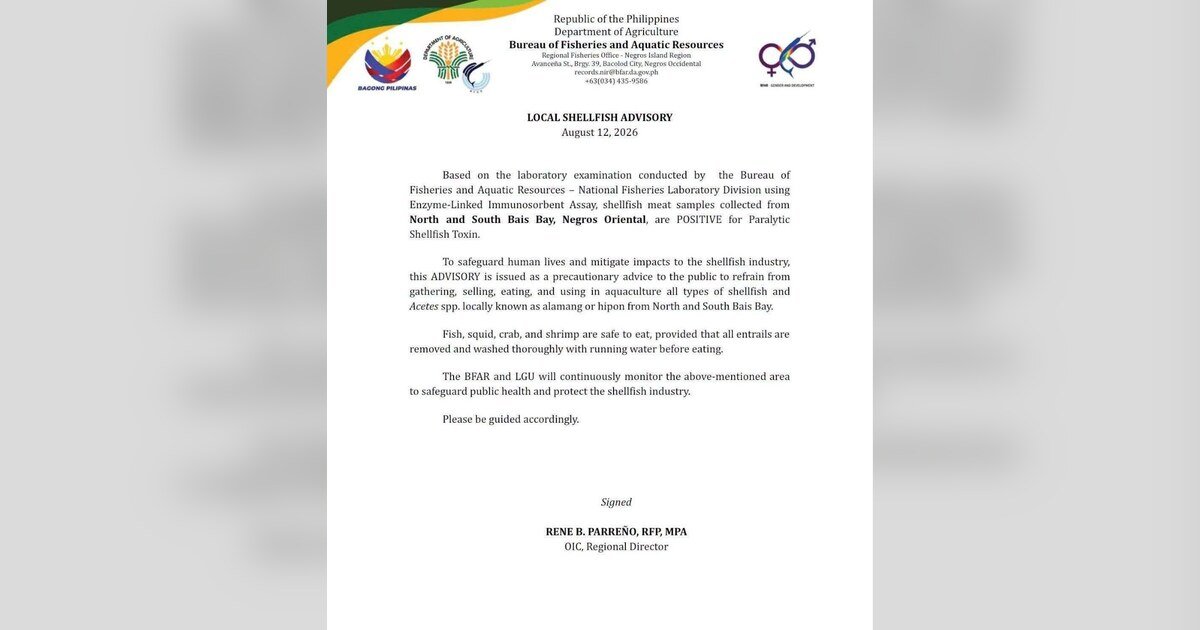
A health and safety advisory banning the harvest, trade, consumption, and aquaculture use of shellfish from two coastal bays in Negros Oriental has been formally issued after government laboratory tests came back positive for a dangerous marine toxin. The Bureau of Fisheries and Aquatic Resources (BFAR) announced the prohibition covering North Bais Bay and South Bais Bay, effective as of August 12, 2026.
BFAR Confirms Positive Toxin Results from Both Bays
The BFAR Regional Fisheries Office for the Negros Island Region, operating out of Bacolod City, issued the official advisory after shellfish meat samples taken from both North Bais Bay and South Bais Bay tested positive for paralytic shellfish toxin. The advisory was signed by OIC Regional Director Rene B. Parreño, RFP, MPA.
According to BFAR, the samples were submitted to the BFAR National Fisheries Laboratory Division, where testing was conducted using the Enzyme-Linked Immunosorbent Assay (ELISA) method — a standardized procedure for detecting the presence of harmful biological substances. Both bays returned confirmed positive results, prompting the immediate issuance of the ban.
The bureau stated that the advisory was put in place as a precautionary measure, with the dual aim of protecting public health and cushioning the blow to the local shellfish industry.
Scope of the Ban: Shellfish and Alamang
The prohibition issued by BFAR covers all shellfish species harvested from the two affected bodies of water. Critically, the ban also extends to Acetes spp. — the small crustacean more commonly known in local communities as alamang or hipon. This tiny marine creature is a key raw ingredient in the production of fermented shrimp paste and features prominently in everyday cooking across coastal Visayan communities.
Under the terms of the advisory, members of the public are expressly prohibited from gathering, selling, or eating shellfish and alamang sourced from North or South Bais Bay. Their use in any form of aquaculture operations is likewise forbidden for the duration of the ban.
Which Seafood from the Area Remains Safe
BFAR was careful to clarify that the toxin risk does not apply uniformly to all marine products caught in the affected waters. According to the bureau, fish, squid, crab, and shrimp from North and South Bais Bay are still considered safe for human consumption — but only if handlers and consumers take specific precautions.
The bureau specified that all internal organs and entrails must be completely removed from these species, and the catch must be washed thoroughly under running water before it is cooked or eaten. As long as these handling procedures are observed, BFAR said it has not placed any restrictions on the sale or consumption of these non-shellfish marine products from the area.
Understanding Paralytic Shellfish Poisoning
Paralytic shellfish poisoning (PSP) occurs when toxins produced by certain microscopic algae accumulate within the tissue of filter-feeding shellfish during what are commonly called harmful algal blooms — or red tide events. As shellfish filter large volumes of seawater for feeding, these toxins build up to dangerous concentrations within their bodies.
One of the most alarming characteristics of paralytic shellfish toxin, as noted in the BFAR advisory, is that it cannot be neutralized by heat. Cooking — whether by boiling, frying, steaming, or any other method — does not render contaminated shellfish safe. This makes the toxin especially hazardous, as consumers cannot rely on normal food preparation to eliminate the danger.
Symptoms of PSP typically appear within minutes to a few hours after a person eats contaminated shellfish. Early signs often include a tingling or numbness of the lips, tongue, and mouth. As poisoning progresses, it can cause muscle weakness, impaired coordination, and increasing difficulty breathing. In the most severe cases, PSP can lead to full respiratory failure. BFAR advises that anyone who develops these symptoms after consuming shellfish should seek immediate medical attention without delay.
Ongoing Monitoring by BFAR and Local Government
According to the advisory signed by OIC Regional Director Parreño, BFAR and the relevant local government unit will conduct continuous monitoring of conditions in North and South Bais Bay. The monitoring effort is intended to track toxin levels, protect community health, and limit the economic disruption experienced by those whose livelihoods depend on the shellfish industry in the area.
No end date for the ban was included in the advisory. BFAR’s standard practice is to issue follow-up advisories once subsequent laboratory tests confirm that paralytic shellfish toxin levels in the affected waters have dropped back to safe thresholds. Until such clearance is issued, the ban remains fully in effect.
By the Numbers
- August 12, 2026 — Date the BFAR advisory took effect
- 2 bodies of water affected: North Bais Bay and South Bais Bay
- 1 laboratory testing method used: Enzyme-Linked Immunosorbent Assay (ELISA)
- 4 prohibited activities: gathering, selling, eating, and use in aquaculture
- 4 seafood types deemed safe with proper handling: fish, squid, crab, and shrimp
Why This Matters
The detection of paralytic shellfish toxin in both Bais Bay bodies of water presents a direct and immediate risk to public health, made more serious by the fact that the toxin survives cooking — stripping consumers of the most common safeguard against foodborne illness. Coastal communities that depend on shellfish gathering for daily sustenance or commercial income face both a health threat and a disruption to their economic activity for an indefinite period.
The inclusion of alamang in the ban broadens its reach considerably, given how widely this small crustacean is harvested and processed in Negros Oriental’s coastal barangays. Wide public awareness of the BFAR advisory is essential to preventing poisoning incidents among residents who may not yet know the ban is in place.
Source: Bureau of Fisheries and Aquatic Resources (BFAR) — Negros Island Region Advisory, as originally reported by breakingnewsnegrosoriental.com