Standfirst: The rule that lets a ward patient walk out owing nothing used to apply only to certain member types. Under the Universal Health Care Law it was broadened to all members. Most people still assume it is not for them.
Conditions apply and they are specific — read the accommodation rule below before relying on this.
The change most members have not registered
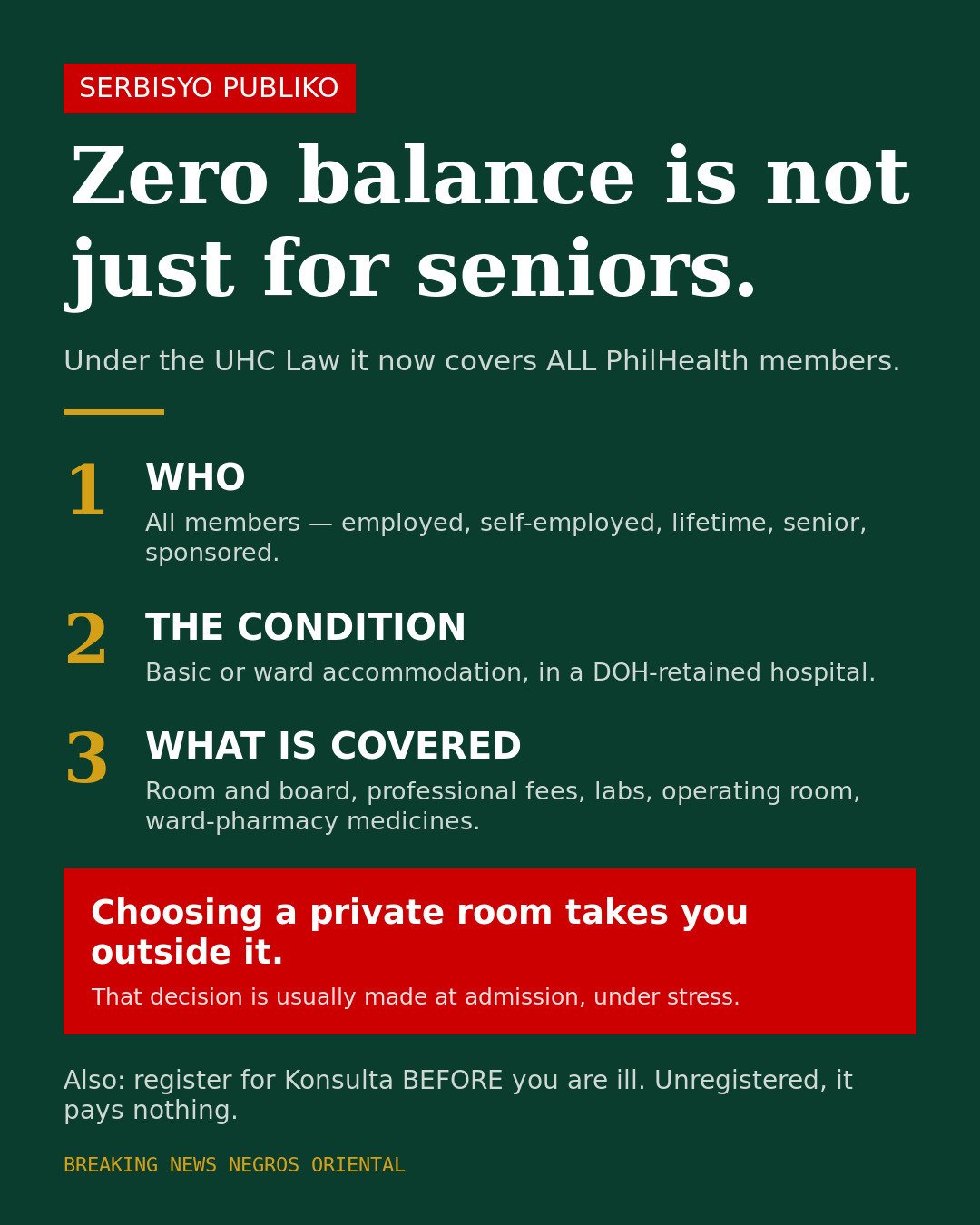
No Balance Billing, also called Zero Balance Billing, means a ₱0 out-of-pocket balance for the confinement: room and board, professional fees, laboratory tests, operating room services, and medicines available at the hospital pharmacy.
It used to be limited to senior citizens, indigent and sponsored members, and household workers. Under the Universal Health Care Law it now covers all PhilHealth members — employed, self-employed, lifetime, senior and sponsored alike.
The condition is the accommodation. The entitlement applies to patients admitted to basic or ward-type accommodation in DOH-retained hospitals. Choosing a private room takes you outside it. That single choice, often made at admission under stress, is what decides whether the bill is zero.
The four things PhilHealth actually pays through
Case rates. Most inpatient coverage is a fixed amount per condition, covering hospital charges and professional fees together. Published examples include pneumonia at ₱32,000, appendectomy at ₱24,000, caesarean section at ₱19,000 and dengue at ₱16,000. The amount is fixed by the case, not by what the hospital charges — which is why the accommodation rule matters so much.
Konsulta — the one most people never claim. PhilHealth’s primary care programme covers outpatient consultations, basic laboratory tests, and medicines for common conditions including hypertension and diabetes. Every member is entitled to register with one Konsulta provider, who becomes their primary care physician for the year. PhilHealth pays that provider a capitation fee — around ₱500 per enrolled member per year — to deliver the defined services at no cost to you.
You have to register with a provider for it to exist. Unregistered, it pays nothing and no one tells you.
Z Benefits. Packages for catastrophic illness — cancers, kidney transplant — running to over ₱1 million. These have their own accreditation and contracting rules and are available only at specific contracted centres.
Maternity and newborn packages. Covered separately, with rates that differ by facility type. See our guide to the ₱29,000 versus ₱14,000 difference.
What to settle before an admission
- Ask for basic or ward accommodation if zero balance billing matters to you, and confirm the hospital is DOH-retained
- Confirm your membership is active — an inactive record at the time of admission is a common reason a claim fails
- Ask which case rate applies to the admitting diagnosis
- Register for Konsulta now, not when you are ill
Where to check
PhilHealth publishes its benefit packages, case rates, circulars and the list of accredited facilities at philhealth.gov.ph. Because case rates and package rules are revised by circular, confirm the current figure for your condition rather than relying on a number you were told previously.
Our separate guide explains why a DOH licence and PhilHealth accreditation are not the same approval — and why the facility’s accreditation, not the doctor’s, decides whether anything is deducted.
Sources: PhilHealth published benefit packages, case rates and circulars; Universal Health Care Law and the expansion of No Balance Billing to all member categories in basic or ward accommodation in DOH-retained hospitals; PhilHealth Konsulta primary care package and capitation arrangement; PhilHealth Z Benefits.
Related stories