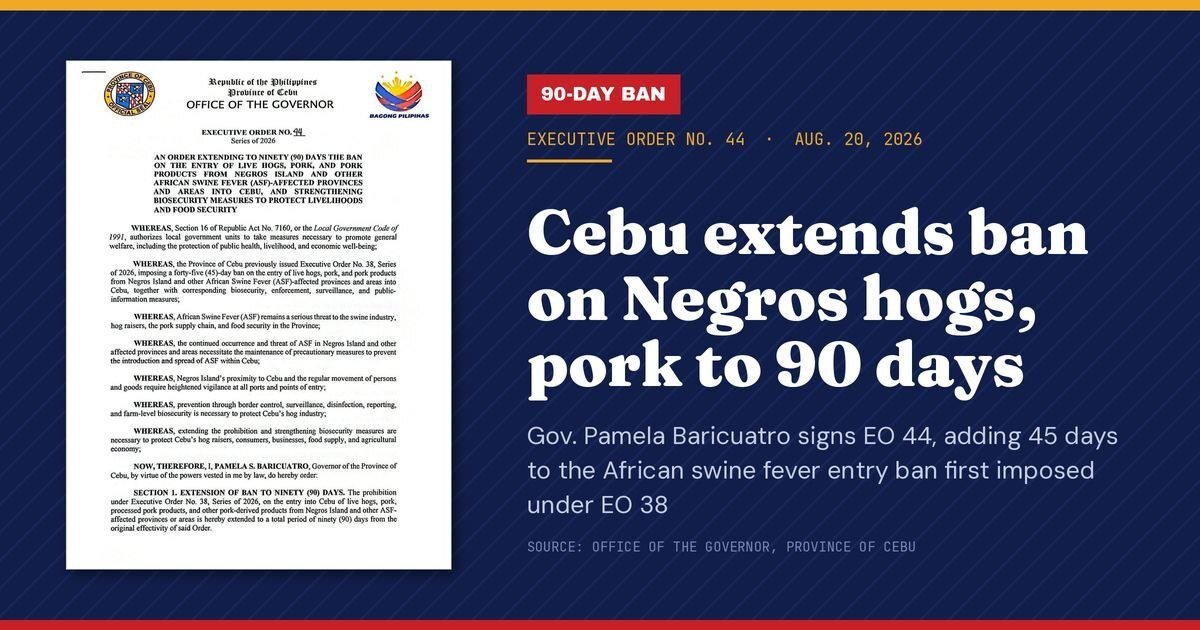
A new executive order has locked in a full 90-day prohibition on pork and live hogs entering Cebu from Negros Island, as the provincial government moves to shield its swine industry from the continued spread of African swine fever (ASF) across the region.
Cebu Governor Pamela S. Baricuatro signed Executive Order No. 44 on August 20, 2026, formally extending a restriction that had already been in place for 45 days under the earlier Executive Order No. 38. The new order tacks on another 45 days, bringing the total ban to 90 days counted from the original effectivity date of EO 38.
What the Ban Covers
EO 44 casts a wide net on what is prohibited. According to the executive order, no person or entity may bring into Cebu — whether for commercial or personal purposes — any live domestic or wild pigs, fresh, chilled, or frozen pork, processed pork products, or other pork-derived commodities that originate from Negros Island or any other ASF-affected area or province.
The prohibition applies to all modes of entry and covers every stage of movement: transport, shipment, conveyance, delivery, and introduction into the province. The order took effect immediately upon signing and remains enforceable for the remainder of the 90-day period, unless the governor revokes, amends, or further extends it before that period lapses.
Stronger Enforcement at All Entry Points
Governor Baricuatro’s order directs the Provincial Veterinarian’s Office (PVO) to step up inspections across all ports, airports, wharves, roll-on/roll-off (RoRo) terminals, private landing areas, and other points of entry into Cebu. The PVO is to work alongside national agencies, local government units, port authorities, and law enforcement in carrying out these checks.
Under EO 44, any shipment reasonably suspected of containing prohibited or regulated goods is subject to inspection and verification. The executive order further states that unauthorized or prohibited shipments may be denied entry outright, confiscated, returned to their place of origin, or disposed of in accordance with applicable laws and regulations.
The PVO is also authorized to issue implementing guidelines that detail the specific products covered by the ban. In coordination with the Department of Agriculture (DA) and the Bureau of Animal Industry (BAI), the office may identify additional swine products, by-products, materials, or articles that pose a meaningful risk of ASF transmission.
Biosecurity Obligations on Hog Industry Operators
Beyond the import ban, EO 44 imposes mandatory biosecurity requirements on hog raisers, swine farms, livestock traders, meat dealers, slaughterhouses, and transporters operating within Cebu. The executive order spells out specific obligations that covered operators must follow:
- Limit farm access to authorized personnel only
- Install and maintain disinfection facilities at all farm entry and exit points
- Regularly disinfect and clean vehicles, equipment, crates, footwear, and clothing used in farm operations
- Ban unauthorized movement of live hogs and regulated pork products within and out of their facilities
- Keep accurate records of hog movement, purchases, sales, transfers, and sources
- Immediately isolate any animal displaying ASF symptoms and promptly report such cases to the city or municipal veterinarian or to the PVO
- Ensure that no animals are introduced into farms without the required veterinary health certificates, shipping permits, or other supporting documentation
These on-farm requirements reflect a broader strategy to reduce the risk of ASF spreading within Cebu even as authorities work to block its entry from outside the province.
Ongoing Risk Assessment by the PVO
The Provincial Veterinarian’s Office will not simply enforce the ban and wait — it is also tasked with continuously monitoring the ASF situation both within Cebu and in neighboring provinces. According to the executive order, the PVO will regularly advise Governor Baricuatro on whether the prohibition should be lifted, modified, maintained as is, or extended further.
The DA and BAI noted that risk assessments under EO 44 will factor in official advisories from national agencies, laboratory and surveillance data, epidemiological developments, and any other identified risk factors. Provisions of EO 38 that do not conflict with EO 44 remain in effect alongside the new order.
The layered approach — combining a movement ban, tightened border enforcement, farm-level biosecurity mandates, and continuous risk monitoring — reflects the seriousness with which the Cebu provincial government is treating the ASF threat originating from affected areas including Negros Island.
By the Numbers
- 90 days — total duration of the pork and live hog ban, counted from the original effectivity date of EO 38
- 45 days — length of the original ban under Executive Order No. 38
- 45 days — additional days appended by Executive Order No. 44
- August 20, 2026 — date Governor Baricuatro signed EO 44
Why This Matters
African swine fever remains incurable and has no approved vaccine available for widespread use, which means movement restrictions and biosecurity enforcement are the primary lines of defense against its spread. Extending the ban to 90 days and expanding its enforcement scope — including private landing areas and RoRo facilities — signals that Cebu’s provincial government regards the regional ASF situation as far from resolved.
The prohibition directly affects the movement of pork and live hogs from Negros Island into Cebu, with consequences for traders, transporters, hog raisers, and consumers on both islands. By simultaneously mandating on-farm biosecurity measures, EO 44 aims not only to keep ASF out of Cebu but also to prevent any outbreak from taking hold within the province’s own swine industry.
Source: Breaking News Negros Oriental / Province of Cebu official records