
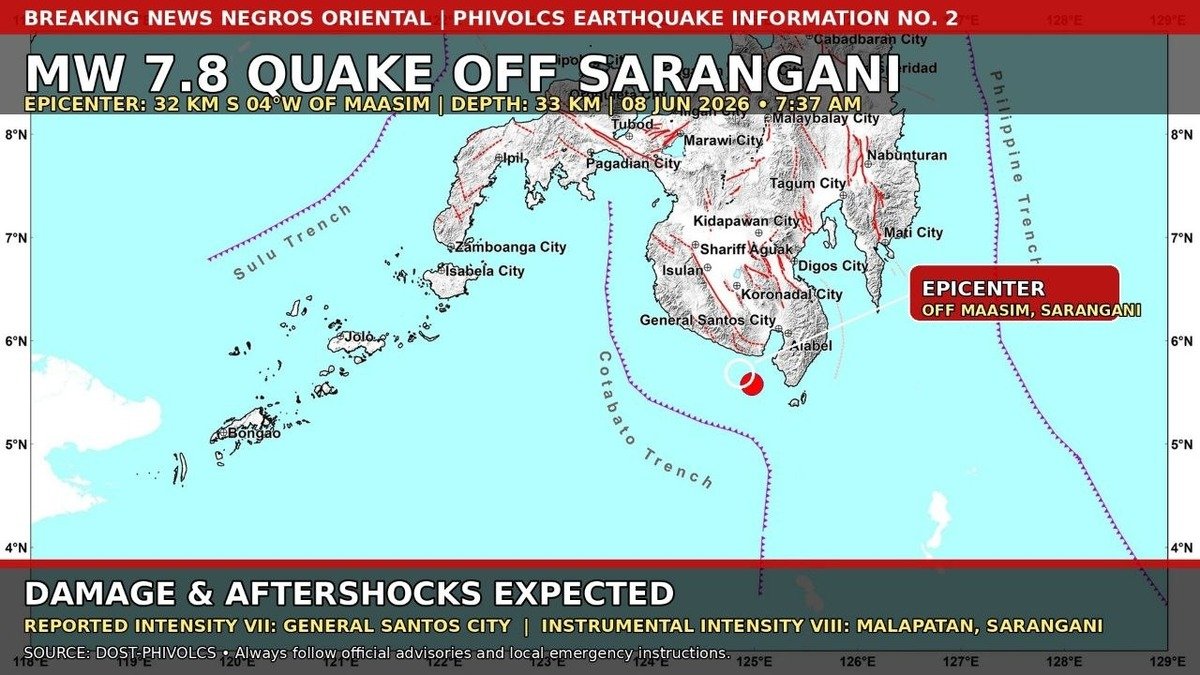
Evacuation orders swept across coastal Mindanao on Monday morning, June 8, after a powerful earthquake measuring magnitude 7.8 struck off the coast of Sarangani province at 7:37 a.m., sending residents scrambling for higher ground and prompting tsunami warnings from both local and international disaster monitoring agencies.
PHIVOLCS Issues Tsunami Warning, Upgrades Quake Magnitude
The Philippine Institute of Volcanology and Seismology (PHIVOLCS) first recorded the tremor at magnitude 7.0, with a shallow depth of 10 kilometers. In a subsequent advisory, PHIVOLCS upgraded the magnitude to 7.8, revising the depth to 33 kilometers. The agency placed the epicenter at coordinates 05.57°N, 124.98°E — approximately 32 kilometers south of Maasim, Sarangani.
PHIVOLCS warned the public that the earthquake was capable of causing significant structural damage, and that tsunami waves exceeding one meter in height could persist for several hours following the initial tremor. The agency directed coastal residents across multiple Mindanao provinces to evacuate to higher ground without delay.
Adding to the alarm, the US Tsunami Warning System projected that wave heights could reach between one and three meters above normal tide levels in affected portions of the country. Indonesia similarly activated its own tsunami warning protocols for vulnerable coastal zones, while Japan’s Meteorological Agency issued a separate tsunami advisory covering parts of its southern coastline.
General Santos City Hit Hardest by Shaking
The most intense ground shaking was recorded in General Santos City, roughly 15 kilometers from the epicenter, where PHIVOLCS logged Intensity VII — categorized as “destructive” on the seismic intensity scale. Radio reports from the city described scenes of overturned furniture, damaged appliances, and panicked residents fleeing into the streets as aftershocks continued to roll through the area.
Photographs circulating from General Santos City showed at least one Jollibee outlet had collapsed, along with other damaged structures in the city. The General Santos City disaster office confirmed that aftershocks were ongoing and that local authorities were in the process of tallying reports of property damage and personal injuries. As of the latest available bulletins, no official death toll had been confirmed. PHIVOLCS noted that further damage and continued aftershocks should be expected in the coming hours.
Sarangani: Power Down, Telecoms Cut, Assessment Ongoing
In Sarangani province, situated closest to the earthquake’s epicenter, power supply was disrupted and telecommunications systems were knocked offline. Classes were suspended across the area as a precautionary measure. Local disaster chief Rene Punzalan told authorities that a comprehensive damage assessment was being carried out, though no reports of completely collapsed buildings had been received at that point.
In the town of Alabel, the local police building sustained visible cracks during the earthquake, which struck while a flag-raising ceremony was underway. Several attendees reportedly fainted amid the violent shaking. Alabel Police Chief Benjie Ancheta described the event as the strongest earthquake he and his officers had ever experienced.
Maasim: Coastal Evacuation Underway as Water Recedes
In Maasim — the municipality nearest to the reported epicenter — local disaster chief Arlene Hollero confirmed that evacuation of coastal villages was actively underway. A particularly alarming sign was observed shortly after the quake: seawater briefly pulled back from the shoreline, a phenomenon widely recognized as a potential precursor to incoming tsunami waves.
Physical damage in Maasim included a cracked bridge and the collapse of a roadside shrine featuring a large cross. Residents in low-lying coastal areas were urged to move inland immediately and not to return to the shore until authorities declared it safe to do so.
Marcos Calls for Immediate Compliance, Activates National Response
President Ferdinand Marcos Jr. addressed the nation and appealed directly to Filipinos living in the affected provinces to take the tsunami warning seriously and relocate to higher ground without hesitation. “Do not wait,” the President said in his statement, stressing the urgency of the situation.
Marcos also assured affected communities that the national government would “not leave Mindanao behind,” and confirmed that he had directed all relevant government agencies to mobilize immediately. The Office of Civil Defense and the National Disaster Risk Reduction and Management Council (NDRRMC) were placed in charge of coordinating the overall disaster response effort.
Situation Remains Fluid
As of the latest reports, the full scale of destruction had yet to be determined, with damage assessments still ongoing across multiple provinces. Residents in coastal areas of the affected provinces were reminded to stay away from shorelines and to monitor official advisories from PHIVOLCS and the NDRRMC for the latest updates. Aftershocks are expected to continue, and conditions on the ground remain fluid as responders work to reach all affected communities.
This is a developing story. Updates will be posted as new information becomes available.
Originally reported by: Philippine Institute of Volcanology and Seismology (PHIVOLCS)
Related stories