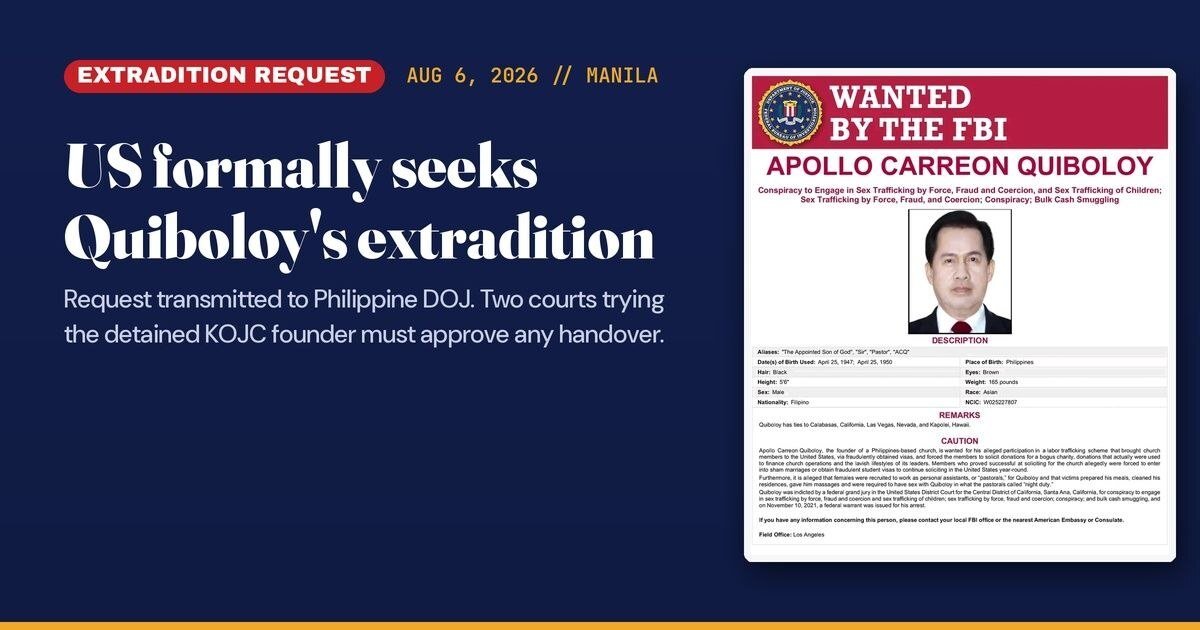
Washington has taken a decisive procedural step in its pursuit of Kingdom of Jesus Christ (KOJC) founder Apollo Carreon Quiboloy, formally transmitting an extradition request to Philippine authorities — a move that sets in motion a legal evaluation process under the bilateral treaty between the two countries. Philippine Ambassador to the United States Jose Manuel Romualdez confirmed the development on Thursday, August 6, nearly twelve months after Washington’s intent to seek custody of the self-proclaimed “Appointed Son of God” first became publicly known.
“The formal request was transmitted to the Department of Justice,” Ambassador Romualdez said, as quoted by Philstar.
Two senior Philippine government officials, who spoke to the Associated Press on the condition that their identities not be disclosed, said the request was routed through the Department of Foreign Affairs to the Department of Justice in July. Both officials noted that any actual surrender of Quiboloy to US custody would still require the approval of the two Philippine courts currently trying him on separate criminal charges.
DOJ Yet to Officially Receive Extradition Documents
Notwithstanding the ambassador’s public confirmation, the Department of Justice said on Thursday that it had not yet officially received documents establishing a formal US extradition request. According to Philstar, the DOJ clarified that under the Philippine-US Extradition Treaty, the Department of Foreign Affairs serves as the initial point of contact for such matters, and that early inquiries should be directed there first.
The US Embassy in Manila, for its part, did not provide an immediate response to a request for comment, The Manila Times reported.
The formal transmission of the extradition request is a procedurally significant event — it serves as the trigger under Philippine law for authorities to begin evaluating Washington’s petition. The DOJ reviews the adequacy of the submitted documents and, if it finds them sufficient, assigns a government attorney to file an extradition petition before a trial court.
Federal Indictment and FBI Most Wanted Status
According to Philstar, Quiboloy was indicted by a US federal grand jury in 2021 on a range of serious charges: conspiracy to engage in sex trafficking through force, fraud, and coercion; sex trafficking of children; substantive sex trafficking; conspiracy; and bulk cash smuggling. A federal arrest warrant followed on November 10, 2021, after which Quiboloy was placed on the FBI’s most wanted list. The case is being handled by the bureau’s Los Angeles field office.
Federal prosecutors allege that Quiboloy and other KOJC officials recruited women and young girls to serve as personal assistants — known within the organization as “pastorals” — and coerced them into sexual acts. The FBI’s wanted notice further describes an alleged labor trafficking scheme in which church members were brought into the United States on fraudulently obtained visas to collect donations for what prosecutors characterize as a sham charity.
Quiboloy has rejected all charges against him, maintaining that the allegations were fabricated by critics and former church members who had been removed from his organization, according to both Philstar and the Seymour Tribune.
Philippine Cases Hold Priority Over Foreign Extradition
Quiboloy is currently being held in detention in the Philippines while facing child abuse and sexual abuse charges before a Quezon City court. He and several co-accused additionally face non-bailable qualified human trafficking charges before a Pasig court.
The DOJ stated in 2025 that local jurisdiction generally takes precedence, meaning the ongoing domestic criminal proceedings could significantly affect the timeline of any extradition to the United States. Philstar reported that it is ultimately the courts — not the executive branch acting alone — that will determine how those proceedings unfold.
The two Philippine courts handling his cases therefore hold considerable influence over when, or even whether, a handover to US authorities can realistically take place.
Arrest Followed Mass Police Raid on Davao Compound
Quiboloy had gone into hiding in 2024 after a Philippine court issued an arrest warrant against him. He eventually surrendered alongside four others in September 2024, following a large-scale law enforcement operation in which approximately 2,000 police officers raided the KOJC’s 30-hectare compound in Davao City, according to the Seymour Tribune.
Philstar reported that he was formally taken into custody on September 8, 2024, and has remained incarcerated since that date.
A Fall From Political Influence to Criminal Defendant
At the peak of his prominence, the 76-year-old televangelist was widely considered a political kingmaker in the Philippines and served as spiritual adviser to former president Rodrigo Duterte, according to the Seymour Tribune. Duterte himself is currently detained at The Hague, where he stands before the International Criminal Court on charges of crimes against humanity.
CBS17 reported that Quiboloy established the KOJC in Davao City in 1985 and has since built a substantial following both within the Philippines and internationally, including a notable presence in the United States.
By the Numbers
- 2021 — Year a US federal grand jury handed down an indictment against Quiboloy
- November 10, 2021 — Date the US federal arrest warrant was issued
- 2,000 — Number of police officers deployed in the raid on the KOJC compound in Davao City
- 30 hectares — Area of the KOJC compound raided by Philippine authorities
- September 8, 2024 — Date Quiboloy was taken into custody in the Philippines
- 1985 — Year Quiboloy founded the KOJC in Davao City
- 76 — Quiboloy’s age at the time of reporting
Why This Matters
The formal filing of a US extradition request represents a concrete escalation in the international legal proceedings against Quiboloy, who faces grave federal charges — including child sex trafficking and bulk cash smuggling — in the United States. Because two active, non-bailable criminal cases are simultaneously proceeding before Philippine courts, domestic legal priority rules create real uncertainty around when or whether an actual handover to US authorities can occur. The parallel situations of Quiboloy and his former political patron, Rodrigo Duterte — both simultaneously facing prosecution, one in Philippine courts and one before an international tribunal — underscore the extent to which figures who wielded extraordinary influence during the Duterte era are now confronting serious legal accountability.
Source: Philstar, The Manila Times, Associated Press, Seymour Tribune, CBS17