
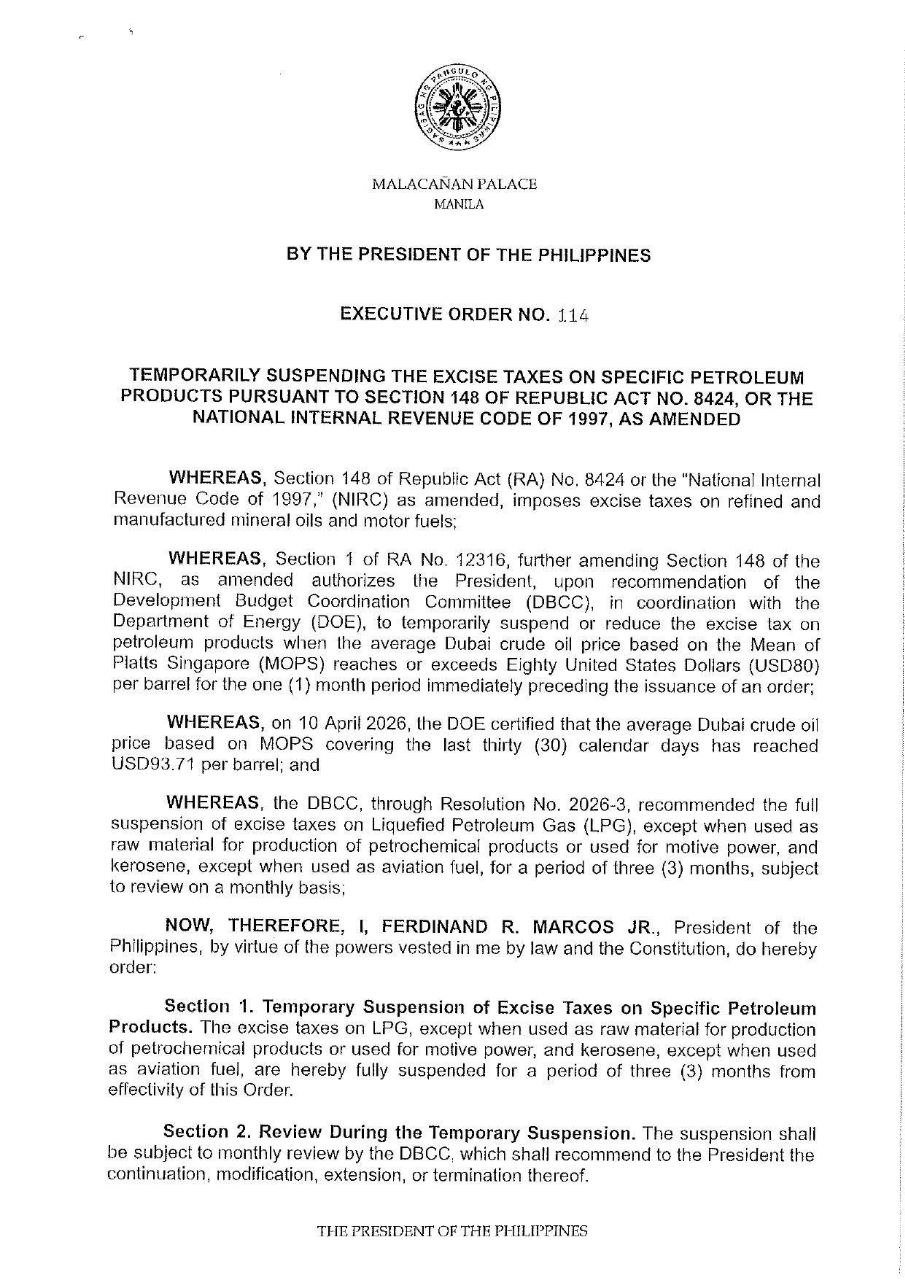
Executive Order No. 114, signed by President Ferdinand Marcos Jr., has eliminated excise taxes on liquefied petroleum gas and kerosene for a three-month period, taking effect immediately as global crude oil prices continue to surge beyond critical thresholds.
Malacañang Palace released the order, dated April 16, 2026, after the Department of Energy validated that Dubai crude oil prices averaged $93.71 per barrel over a 30-day monitoring period, as measured by the Mean of Platts Singapore benchmark on April 10.
The tax elimination covers LPG for household and commercial use, excluding petrochemical raw materials and motive power applications, while kerosene benefits from the suspension except when utilized as aviation fuel. The initiative targets consumer relief amid escalating international energy expenses.
Statutory Authority Enables Swift Action
Republic Act No. 12316, which modified Section 148 of the National Internal Revenue Code of 1997, provides the legal foundation for the presidential action. This legislation empowers the chief executive to suspend or reduce petroleum excise taxes when Dubai crude oil prices maintain $80 per barrel or higher for 30 consecutive days.
The Development Budget Coordination Committee issued Resolution No. 2026-3, recommending complete tax suspension in collaboration with energy officials. The committee specifically endorsed a three-month implementation period with mandatory monthly assessments.
The executive order notes that current oil pricing at $93.71 per barrel substantially surpasses the statutory $80 trigger point, warranting immediate activation of consumer protection measures.
Built-in Evaluation System Required
Monthly evaluations by the DBCC will determine whether to maintain, adjust, extend, or conclude the tax suspension based on evolving global petroleum market dynamics. This oversight mechanism ensures policy flexibility in response to changing economic conditions.
Standard excise tax rates will resume under specific circumstances: seven days after the monthly average Dubai crude price drops below $80 per barrel with DOE certification, or when the three-month period expires, whichever comes first.
The automatic restoration feature ensures the suspension remains temporary and market-driven rather than subject to political influence.
Multi-Agency Coordination Framework
The order assigns implementation responsibilities across several government departments. The DOE and Department of Finance, working through the Bureau of Internal Revenue and Bureau of Customs, must catalog existing petroleum product inventories from the effective date.
Monthly congressional reports detailing declared values and volumes of covered petroleum products become mandatory for the BIR and BOC. This reporting structure provides transparency and enables legislative oversight of program execution.
Oil companies must furnish monthly cost breakdown information for affected petroleum products to the DOE during the suspension period. The energy department will transmit this data to both the DBCC and Congress in compliance with statutory requirements.
Regulatory Implementation Structure
The DOF, through its revenue agencies, and the DOE receive authorization to develop implementing rules, regulations, and guidelines ensuring effective order execution. These agencies will monitor compliance with Republic Act No. 12316 provisions.
Standard separability clauses protect the order’s validity if legal challenges arise against specific sections. Constitutional or validity challenges to individual provisions will not affect the remaining sections’ enforceability.
Previous orders, regulations, and directives conflicting with the new executive order face automatic repeal or modification to eliminate contradictory requirements.
Direct Benefits for Filipino Consumers
The tax suspension delivers immediate financial relief to households dependent on LPG for cooking needs and kerosene for various domestic applications. LPG serves as the primary cooking fuel for millions of Filipino families, especially in metropolitan areas where it has replaced traditional cooking methods.
While kerosene usage has declined compared to previous generations, it remains essential for heating and illumination in remote rural areas and specialized industrial processes.
The suspension’s timing addresses ongoing global energy market instability affecting petroleum prices internationally. The measure showcases government utilization of established legal tools to counter external price pressures.
Legislative Oversight Provisions
Comprehensive congressional monitoring operates through mandatory monthly documentation requirements. Legislative bodies will access detailed petroleum product volume and value data, facilitating scrutiny of program administration.
Mandatory oil company cost reporting creates enhanced transparency in petroleum pricing throughout the suspension period. This information assists policymakers in evaluating the tax suspension’s effectiveness in delivering consumer benefits.
Acting Executive Secretary Ralph G. Recto countersigned the immediately effective executive order. The directive represents substantial executive intervention addressing economic challenges confronting Filipino consumers amid volatile global energy conditions.
The measure demonstrates proactive government response to international market pressures while maintaining accountability through legislative reporting and automatic termination mechanisms tied to actual market performance rather than arbitrary timelines.